Layla Zulfa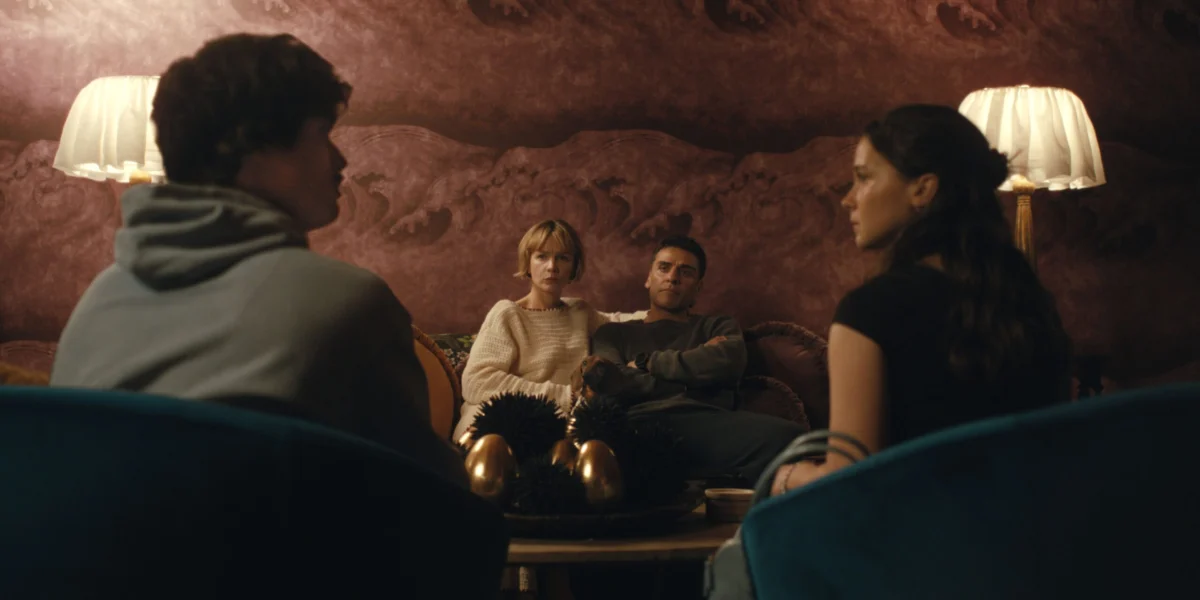
Following the massive critical and commercial success of its debut season, which garnered eight Emmy Awards and multiple Golden Globes, Netflix’s anthology series Beef has returned for a second installment. Created by Lee Sung Jin, the series continues to explore the volatile intersection of human frailty, class tension, and existential dread. While the first season focused on the escalating road-rage incident between Danny Cho (Steven Yeun) and Amy Lau (Ali Wong), the second season shifts its focus to a new ensemble cast, utilizing sophisticated production design and architectural symbolism to illustrate a complex web of blackmail, embezzlement, and cultural displacement.
.jpg)
The narrative centers on a Gen-Z couple, Ashley Miller (Cailee Spaeny) and Austin Davis (Charles Melton), who serve as low-level employees at Monte Vista Point, an ultra-exclusive country club. Their lives intersect violently with the club’s General Manager, Josh Martin (Oscar Isaac), and his wife, interior designer Lindsay Crane-Martin (Carey Mulligan). After witnessing a domestic dispute between the Martins, Ashley and Austin attempt a blackmail scheme that quickly spirals out of control, eventually drawing in the club’s new owner, a South Korean billionaire known as Chairwoman Park (Youn Yuh-jung).
The Architecture of Class Disparity
In Beef Season 2, the setting of Monte Vista Point acts as a silent protagonist. The club’s aesthetic—a meticulously curated Spanish Colonial Revival style characterized by stucco façades, red-tiled accents, and arched arcades—represents an idealized, static version of American wealth. Production designers utilized this "Old Money" aesthetic to create a sense of timelessness, which the characters find both comforting and suffocating.
.jpg)
The opening sequence of the season introduces a surreal festival at the club where all four seasons are represented simultaneously: children play in artificial snow alongside pumpkins, haystacks, and pastel spring flowers. This visual choice establishes the theme of "make-believe" that Josh Martin explicitly references later in the season. For the elite members of Monte Vista Point, the club is a controlled environment where the natural laws of time and consequence are suspended.
In contrast, the living spaces of the working-class protagonists, Ashley and Austin, reveal the "derivative" nature of their aspirations. Their apartment features a color palette nearly identical to the country club’s parlor—robin’s egg blue and soft pastels—suggesting that their identities are shaped by the very institution that exploits them. Observers of the show’s design have noted that Austin’s reliance on copying fitness influencers for his online tutorials mirrors this lack of original identity, as he attempts to "curate" a life he cannot yet afford.

Chronology of the Conflict
The escalation of the plot follows a precise timeline of moral and financial decay:
- The Witnessing: Ashley and Austin, while delivering a package to Josh Martin’s home, witness a violent altercation through a window. This "peek through the glass" serves as a metaphor for the thin veil between public prestige and private misery.
- The Blackmail Attempt: Motivated by financial instability and a desire for upward mobility, the young couple attempts to extort Josh Martin.
- The Power Shift: Chairwoman Park acquires Monte Vista Point and discovers that Josh has been siphoning funds from the club’s accounts for years.
- The Pivot to Medical Tourism: To cover her own looming scandals, Chairwoman Park co-opts the two couples into a scheme involving "Trochos," a high-end plastic surgery clinic in South Korea owned by her husband.
- The International Spiral: The conflict moves from the manicured lawns of California to the sterile, dystopian halls of the Trochos clinic, where the characters’ physical and psychological boundaries are systematically dismantled.
Symbolism in Interior Design
The Martin residence offers a stark contrast to the public-facing beauty of the country club. While the exterior appears charming, the interior is described as heavy, dark, and cluttered. Lindsay Crane-Martin, despite being an interior designer, has lived in the house for six years without "finishing" it. The presence of multiple bars and alcohol bottles in nearly every room highlights the couple’s reliance on substances to endure their failing marriage.

The backhouse, where Josh Martin spends much of his time, is depicted as a separate ecosystem filled with country club memorabilia and golf clubs. When Lindsay eventually smashes these items, it represents a rejection of the "staff" identity she feels Josh has forced upon her.
The introduction of Chairwoman Park brings a new aesthetic language to the series. Her personal style and home are defined by "Zen minimalism"—clean lines, low furniture, and a neutral palette of stone, wood, and glass. This shift from Lindsay’s "colonial" and "frilly" designs to Park’s cold, airy spaces signals a transfer of power from the failing American middle-management class to a new tier of global, hyper-wealthy elite.

Critical Analysis of Thematic Implications
A pivotal moment in the season occurs when Chairwoman Park critiques the parlor designed by Lindsay. Park labels the design "colonial" and dismisses the pastel tassels and floral curtains as "forgettable." This exchange highlights a deeper racial and cultural tension. While Lindsay views her work as an aristocratic fantasy, Park sees it as a relic of an outdated power structure.
The "china" vs. "dishware" correction made by Josh during a meeting with Park further illustrates the awkward racial dynamics at play. Josh’s panicked attempt to be "politically correct" in front of a Korean billionaire underscores his own insecurity regarding his status.

The Trochos clinic in Korea serves as the narrative’s climax. The facility is portrayed as a sterile, monochrome version of Chairwoman Park’s home. The use of translucent walls in the treatment rooms allows Josh and Lindsay to see each other’s silhouettes but prevents actual contact—a visual echo of the windows in their home through which they previously observed each other’s infidelities. This "prison of glass" suggests that even in their most vulnerable states, the characters remain separated by the walls they built through years of deceit.
Supporting Data and Production Context
The production of Beef Season 2 saw a significant increase in budget and scale following the success of Season 1. According to industry reports, the decision to cast Oscar Isaac and Carey Mulligan—both Academy Award nominees—was a strategic move by Netflix to solidify the show’s status as a prestige anthology series.

- Cast Statistics: The season features three actors with significant accolades: Youn Yuh-jung (Academy Award winner for Minari), Carey Mulligan (three-time Academy Award nominee), and Oscar Isaac (Golden Globe winner).
- Thematic Continuity: Creator Lee Sung Jin has stated in interviews that the "Beef" of the title refers not just to a grudge, but to the "meat" or substance of human ego. The transition from the urban sprawl of Los Angeles in Season 1 to the insular world of a country club in Season 2 allows the show to explore how wealth modifies, but does not eliminate, basic human resentment.
- Visual Motifs: The "clocks" in Josh Martin’s office—multiple ticking timepieces on a single wall—serve as a recurring motif for the anxiety of the "numbered days" of his embezzlement scheme.
Broader Impact and Industry Reception
The release of Beef Season 2 has sparked renewed discussion regarding the "Rich People Behaving Badly" subgenre of television, often compared to HBO’s The White Lotus and Succession. However, Beef distinguishes itself by maintaining a focus on the "middlemen" and the staff who are caught in the gravity of the ultra-wealthy.
The season concludes with a return to the "four seasons" festival at Monte Vista Point. In a cynical twist, Ashley has replaced Josh as the General Manager, and the cycle of artifice continues unabated. The final shot of a cemetery spinning until it resembles a giant clock on the club’s lawn suggests that while individual players may be ruined or replaced, the institution of the elite remains frozen in time.

By utilizing set design as a primary tool for character development, Beef Season 2 reinforces the idea that our environments are not just places where we live, but reflections of our inner turmoil. The disconnect between the "Spanish Colonial" dream and the "minimalist" reality serves as a powerful indictment of the modern pursuit of status, leaving the audience to wonder if any of the characters ever truly "arrived" at the destination they were so desperately seeking.