Prabowo Widodo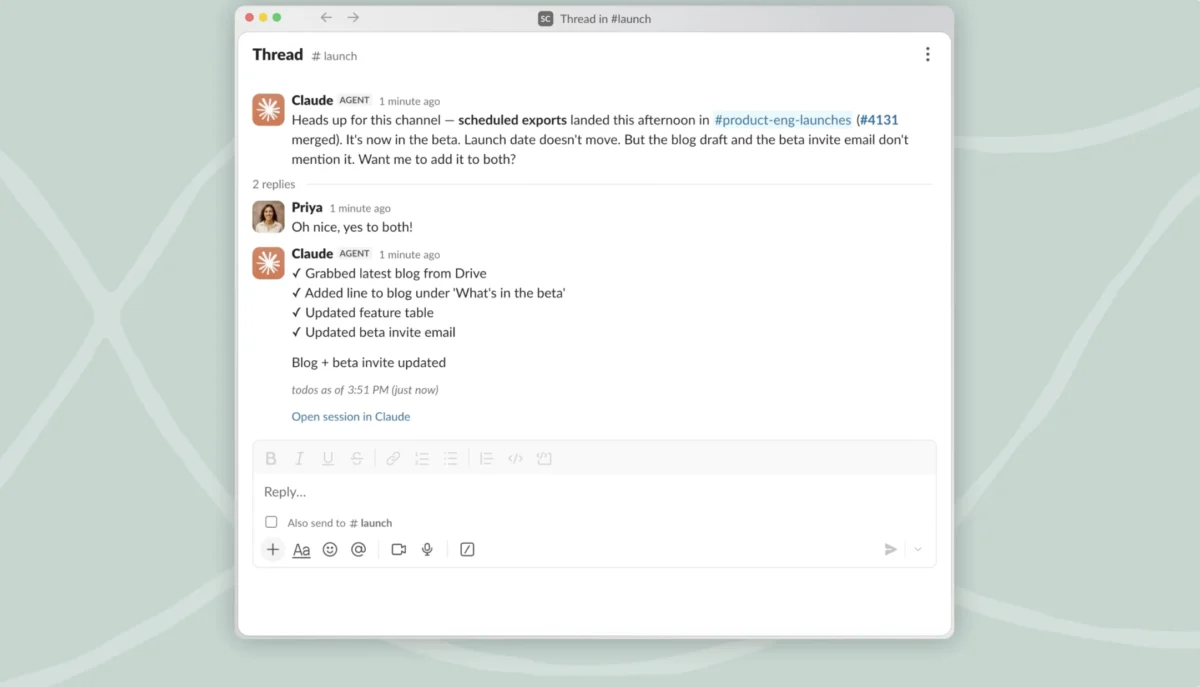
Anthropic, a leading artificial intelligence research and development company, has unveiled Claude Tag, an innovative feature designed to integrate its advanced Claude AI directly into Slack as a persistent, "always-on" AI teammate. This new functionality, currently in research preview, allows users to tag @Claude within Slack channels to solicit insights, assign tasks, and facilitate collaboration. Initially, Claude Tag will be accessible exclusively to Claude Enterprise and Claude Team customers utilizing the Slack platform, marking a significant evolution in how AI interacts with and supports organizational workflows.
The Evolution of AI in Enterprise Communication
The introduction of Claude Tag represents a strategic leap forward from existing AI integrations within workplace communication platforms. For years, companies have explored ways to embed AI into their daily operations, aiming to streamline tasks, enhance information retrieval, and boost productivity. Earlier iterations often involved on-demand interactions, where users would directly message AI bots or tag them for specific, isolated queries.
Anthropic itself has been at the forefront of this integration trend. Users of Claude on Slack have long been able to direct message @Claude for immediate assistance or tag it in channels for ad-hoc support. A notable precursor to Claude Tag was Claude Code in Slack, which intelligently routed coding-related queries from channel mentions to dedicated web-based coding sessions, subsequently posting updates back into the original Slack thread. These integrations, while valuable, typically functioned on a transactional basis, requiring explicit prompts for each interaction and lacking a sustained memory or understanding of ongoing conversations.
Claude Tag fundamentally alters this paradigm by introducing a layer of persistent context and memory. Unlike its predecessors, which largely operated in a stateless manner between interactions, Claude Tag is designed to "follow along with its channel," continuously learning and building an ever-growing understanding of the ongoing work. An Anthropic statement highlights this capability, noting, "As Claude follows along with its channel, it learns ever more about the work." This ambient awareness allows Claude to maintain a comprehensive grasp of discussions, projects, and team dynamics, transforming it from a reactive tool into a proactive, integral participant in team communications. Furthermore, with appropriate permissions, Claude can automatically gather relevant facts and information from other channels across the organization, enriching its understanding and the insights it provides.
Deep Dive into Claude Tag’s Functionality and Features
Claude Tag is engineered to mimic the presence and utility of a human colleague, but with the distinct advantages of AI processing power and memory recall. Its core features are designed to enhance collaboration, automate routine tasks, and provide intelligent support without constant prompting.
Persistent Context and Collective Memory: The most revolutionary aspect of Claude Tag is its ability to retain and leverage context over extended periods. In a given Slack channel, a single Claude identity is shared among all team members. This means that if one person assigns a task or asks a question, Claude’s response and subsequent actions are visible to everyone. More importantly, anyone can pick up the conversation or task from where the last person left off, leveraging Claude’s accumulated knowledge. This shared memory eliminates the need for repeated explanations or re-contextualization, a common inefficiency in team collaboration. For instance, if a team discusses a specific project for weeks, Claude will accumulate all relevant details, decisions, and challenges, making it an invaluable resource for new team members or for revisiting past discussions.
Structured Task Management and Workflow Automation: When assigned a specific task, Claude Tag doesn’t merely provide an answer; it actively works through it. It breaks down complex assignments into manageable stages, utilizing whatever tools and data sources it has been granted access to. Its progress and output are then reported directly back into the Slack thread, ensuring transparency and allowing team members to monitor its work in real-time. This capability moves AI beyond mere information retrieval into direct action and contribution, from drafting reports to summarizing meeting notes, or even initiating data analysis based on available enterprise tools.
The Proactive Ambient Mode: Beyond explicit task assignments, Claude Tag features an innovative "ambient mode." In this mode, Claude proactively engages with the channel, jumping into conversations of its own accord. This might involve keeping the team updated on relevant developments, flagging critical information from other parts of the organization, or following up on discussions and tasks that might have been overlooked or forgotten. This proactive intervention is designed to prevent bottlenecks, ensure timely actions, and bring relevant, often siloed, information to the forefront, acting as an intelligent orchestrator of team activities.
Robust Administrator Controls and Data Governance: Recognizing the critical importance of data privacy, security, and compliance in enterprise environments, Anthropic has built Claude Tag with stringent administrator controls. System administrators are empowered to precisely define which tools, information sources, and channels Claude can access. Each Claude identity is carefully scoped to specific channels, preventing information bleed and ensuring data integrity. For example, a Claude instance configured for a legal team’s channel will not be able to seed its memories or access sensitive legal documents within an engineering channel, and vice-versa. This granular control is vital for maintaining confidentiality, adhering to regulatory requirements, and managing the flow of sensitive corporate information, addressing a primary concern for IT decision-makers.
The Strategic Imperative: Context as the New Frontier in Enterprise AI
The emphasis on "context" and "memory" in Claude Tag is not merely a technical refinement; it reflects a broader, increasingly critical trend in enterprise AI deployments. As businesses integrate AI into more complex workflows, the demand for AI systems that understand the nuances of organizational data, communication patterns, and historical context has surged. Generic AI models, while powerful, often fall short in enterprise settings due to their lack of domain-specific knowledge and an inability to understand the unspoken implications of internal communications.
This focus on contextual intelligence is why several major players in the enterprise technology landscape are also heavily investing in similar capabilities. Microsoft, for instance, leverages its extensive "Graph" technology, which underpins solutions like Copilot and Work IQ, to create a comprehensive digital representation of an organization’s data, interactions, and people. This allows Microsoft’s AI tools to provide highly personalized and contextually relevant assistance across various applications. Similarly, data warehousing and analytics giants like Snowflake and Databricks are positioning their platforms not just as repositories for vast amounts of data, but as the foundational backend support for "tacit organizational knowledge." Their aim is to enable AI agents to tap into this deep well of information, transforming raw data into actionable intelligence. Companies like Glean are building specialized "intelligence layers" that sit between foundational AI models and enterprise data, specifically designed to understand company context and provide a more relevant interface for users. Anthropic’s Claude Tag enters this competitive arena by offering a direct, conversational interface within a ubiquitous communication tool like Slack, promising immediate and visible benefits for team productivity.
Enhancing Productivity and Collaboration in the Modern Workplace
The potential impact of Claude Tag on workplace productivity and team collaboration is substantial. By offloading routine tasks, providing instant access to organizational knowledge, and proactively surfacing critical information, Claude Tag aims to free up human employees to focus on higher-value, more strategic work. A recent survey by McKinsey & Company indicated that generative AI could add trillions of dollars in value to the global economy, with significant portions stemming from enhanced productivity in functions like customer operations, marketing, and R&D. Tools like Claude Tag are designed to tap directly into these potential gains.
Imagine a marketing team brainstorming a new campaign. Claude Tag, having followed their previous discussions and access to marketing collateral, could instantly provide summaries of past campaign performance, competitor analysis drawn from internal reports, or even draft initial messaging ideas, all within the Slack channel. This ability to produce work in public view, with a far greater understanding of context than previously possible, makes Claude Tag feel like a truly integrated team member. Anthropic emphasizes this point, stating it makes users feel like they’re "working with a real colleague – one that can produce work in public view, with far greater context and understanding than before."
Addressing Enterprise Concerns: Security, Privacy, and Ethical AI Deployment
While the benefits of an always-on AI teammate are clear, enterprise adoption hinges on robust solutions for security, data privacy, and ethical AI use. Organizations are increasingly wary of potential data breaches, misuse of sensitive information, and algorithmic bias.
Anthropic, known for its "Constitutional AI" approach that prioritizes safety and alignment, addresses these concerns through its stringent administrative controls. The ability for system administrators to precisely define Claude’s access scope and data permissions is paramount. This ensures that sensitive information remains within designated boundaries and that Claude’s actions align with organizational policies. For instance, an administrator could configure Claude to only access public company documents or specific project folders, preventing it from inadvertently sharing confidential employee data or financial records.
Furthermore, the transparency of Claude’s actions—reporting its progress and output directly in Slack threads—fosters trust and allows for human oversight. This visibility is crucial for accountability and for understanding how the AI is arriving at its conclusions or generating its content. Enterprises considering AI deployment must also develop internal guidelines for AI interaction, data usage, and ethical considerations to maximize benefits while mitigating risks. These include establishing clear human review processes for AI-generated content, training employees on responsible AI interaction, and regularly auditing AI system performance for fairness and accuracy.
The Broader Implications for the Future of Work
The advent of tools like Claude Tag heralds a significant shift in the future of work. It signals a move towards "AI-augmented" teams, where human and artificial intelligences collaborate seamlessly. This paradigm shift will likely lead to:
- Re-definition of Roles: Routine, repetitive, and information-gathering tasks will increasingly be handled by AI, allowing human employees to focus on critical thinking, creativity, strategic planning, and interpersonal communication. This could lead to a more fulfilling work experience and a re-skilling imperative for the workforce.
- Enhanced Decision-Making: With AI proactively surfacing relevant data and insights, human decision-makers will have access to more comprehensive and timely information, potentially leading to better and faster strategic choices.
- Flattening of Hierarchies: By democratizing access to organizational knowledge and automating coordination, AI tools could potentially reduce reliance on traditional hierarchical structures for information flow, fostering more agile and empowered teams.
- New Ethical Frameworks: The persistent nature of AI in communication channels will necessitate new ethical guidelines around transparency, potential biases in AI suggestions, data retention policies, and the distinction between human and AI contributions. Anthropic’s focus on Constitutional AI provides a strong foundation for addressing some of these ethical challenges by embedding principles of helpfulness, harmlessness, and honesty directly into the AI’s training.
Anthropic’s Position and Vision
Anthropic, founded by former members of OpenAI, has distinguished itself through its strong commitment to AI safety and alignment. Its "Constitutional AI" approach aims to train AI models to be helpful, harmless, and honest by having them self-critique and revise their outputs based on a set of guiding principles or a "constitution." Claude Tag, with its emphasis on controlled access, transparency, and integration into a structured enterprise environment, aligns perfectly with this foundational philosophy. By embedding a context-aware AI directly into the fabric of daily team communication, Anthropic is not just offering a new tool but is shaping a future where AI acts as a reliable, intelligent, and ethically guided partner in the workplace.
In conclusion, Anthropic’s Claude Tag is more than just another AI integration; it represents a significant step towards truly intelligent, context-aware, and collaborative AI in the enterprise. By transforming Claude into an "always-on" AI teammate with persistent memory and proactive capabilities, Anthropic is setting a new benchmark for workplace productivity tools, promising to fundamentally alter how teams communicate, collaborate, and achieve their objectives in the digital age. As the research preview unfolds, the insights gained will undoubtedly shape the future trajectory of AI’s role in the modern enterprise.