Johny Marice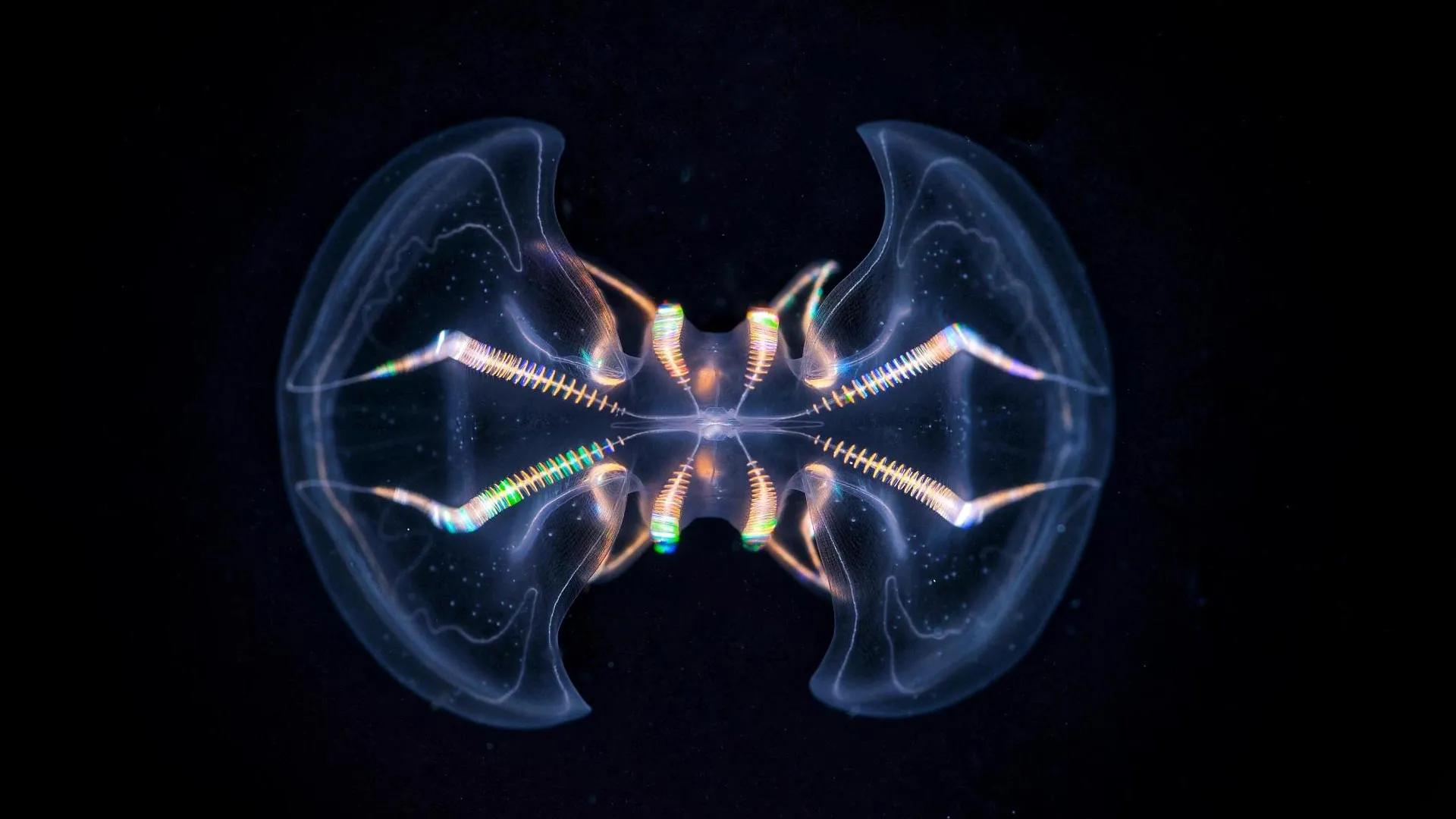
Detailed three dimensional reconstructions of a key sensory structure in ctenophores reveal far greater structural and functional complexity than scientists previously recognized. The results suggest that a simple brain like system may have existed in some of the earliest animals, offering new insight into how nervous systems evolved.
Ancient Architects of Sensation: Unveiling the Aboral Organ
For millions of years, the oceans have been home to the ctenophores, commonly known as comb jellies. These ethereal, gelatinous creatures, which first graced Earth’s waters approximately 550 million years ago, possess a unique sensory apparatus called the aboral organ (AO). This specialized structure plays a critical role in their perception of the world, enabling them to detect subtle shifts in gravity, pressure, and light. A groundbreaking morphological study, recently published in the esteemed journal Science Advances, has unveiled a level of complexity within the aboral organ that far surpasses previous scientific understanding.
"We demonstrate that the aboral organ is a sophisticated and functionally distinct sensory system," stated Pawel Burkhardt, a group leader at the Michael Sars Centre at the University of Bergen. "Our research significantly deepens our comprehension of how behavioral coordination evolved in the animal kingdom."
The study meticulously mapped the cellular architecture of this ancient organ, employing advanced volume electron microscopy. This cutting-edge technique allowed researchers to construct remarkably detailed three-dimensional models of the aboral organ’s internal landscape. The collaborative effort, involving scientists from the Michael Sars Centre and Maike Kittelmann at Oxford Brookes University, aimed to decipher the intricate organization of this vital sensory hub.
A Cellular Tapestry: Unprecedented Diversity Within the Aboral Organ
The painstaking analysis of the aboral organ’s cellular composition yielded astonishing results. Researchers identified an impressive 17 distinct cell types within this single structure. Crucially, 11 of these were identified as secretory and ciliated cell types, previously unknown to science. This remarkable cellular diversity underscores the aboral organ’s role as a highly specialized, multimodal sensory organ, capable of processing a wide array of environmental information.
Anna Ferraioli, a postdoctoral researcher at the Michael Sars Centre and the study’s lead author, expressed her profound astonishment at the findings. "I was amazed almost immediately by the morphological diversity of the aboral organ cells. Working with volume EM data feels like discovering new exciting things every day," she remarked. "The AO has a striking complexity when compared to apical organs of cnidarian and bilaterian. It is so unique!"
This level of cellular specialization within a single sensory organ is unprecedented in many other early animal groups, prompting a reevaluation of the sensory capabilities of these ancient organisms. The sheer variety of cell types suggests a sophisticated integration of sensory inputs, allowing ctenophores to navigate and interact with their environment with a precision not previously attributed to them.
A Hybrid Communication Network: Bridging Synaptic and Non-Synaptic Signaling
Beyond its remarkable cellular diversity, the aboral organ’s intricate connection to the ctenophore’s nervous system has also come to light. Ctenophores possess a unique nerve net, characterized by fused neurons that form a continuous network throughout their bodies. The study revealed that this nerve net establishes direct synaptic connections with cells within the aboral organ. This creates a bidirectional communication pathway, allowing for rapid and targeted signaling between the sensory organ and the wider nervous system.
Furthermore, a significant proportion of cells within the aboral organ were found to contain numerous vesicles. This observation strongly suggests that these cells are capable of releasing widespread chemical signals through a process known as volume transmission. This mechanism allows for the diffusion of signaling molecules over a broader area, complementing the more localized and rapid communication provided by synaptic transmission. The combined action of both synaptic and non-synaptic signaling mechanisms indicates a highly sophisticated and adaptable communication system within the aboral organ.
"I think our work provides an important perspective on how much we can learn from studying morphology," Ferraioli explained. "I would say that the AO is definitely not like our brain, but it could be defined as the organ that ctenophores use as a brain." This statement highlights the functional analogy, emphasizing that while the structure differs from a complex vertebrate brain, its role in processing sensory information and coordinating responses may be analogous to a rudimentary central processing unit in early animals.
Echoes of Early Neural Evolution: Implications for the Origins of Brains
The implications of these findings extend to fundamental questions about the evolution of nervous systems and the emergence of brains. The research team also delved into the expression patterns of certain developmental genes within ctenophores. While many genes crucial for body organization in other animal lineages are present in ctenophores, their expression patterns often diverge significantly.
This divergence suggests that the aboral organ, despite its functional sophistication, may not be a direct evolutionary precursor to the brains found in other animal groups. Instead, it points towards the possibility that centralized nervous systems, or at least complex sensory processing centers, may have evolved independently multiple times throughout the history of life.
"In other words," Burkhardt elaborated, "evolution seems to have invented centralized nervous systems more than once." This hypothesis of convergent evolution in neural complexity challenges the traditional view of a single, linear progression towards complex brains and opens up new avenues for understanding the diverse evolutionary pathways that led to sophisticated nervous systems.
Connecting Neural Architecture to Behavior: A Functional Blueprint
Further corroboration for these groundbreaking insights comes from a parallel study, led by Kei Jokura at the National Institute for Basic Biology in Japan, in collaboration with Professor Gaspar Jekely from Heidelberg University. This independent research, which also involved Burkhardt, focused on reconstructing the complete neural wiring of the ctenophore’s gravity-sensing organ, a component closely linked to the aboral organ.
By integrating high-speed imaging with detailed three-dimensional reconstructions of over 1,000 cells, this study revealed how networks of fused neurons orchestrate the coordinated beating of cilia across different regions of the animal’s body. This precise coordination is essential for comb jellies to maintain their orientation and stability as they navigate the water column. The findings provide a direct link between the neural structure and observable behavior, demonstrating how intricate neural circuits translate into effective locomotion and spatial awareness.
"The similarities to neural circuits in other marine organisms suggest that comparable solutions to gravity sensing may have evolved independently in distant animal lineages," Jokura commented. This observation reinforces the idea that similar environmental challenges can drive the evolution of analogous biological solutions, even in distantly related organisms.
Rethinking the Foundations of Nervous Systems: A New Evolutionary Paradigm
Collectively, these complementary studies present a compelling case for a revised understanding of the early evolution of nervous systems. The research suggests that early nervous systems may have been more centralized and functionally sophisticated than previously theorized, with structures like the ctenophore’s aboral organ serving as early examples of integrated sensory processing and behavioral coordination.
The implications are far-reaching, potentially reshaping our understanding of the evolutionary tree of animal life and the very definition of what constitutes a "brain." According to Ferraioli, the next crucial steps in this line of research will involve identifying the specific molecular characteristics of the newly discovered cell types within the aboral organ. This will provide a deeper understanding of their precise functions and how they contribute to the organ’s overall capabilities. Furthermore, researchers aim to explore the extent to which the aboral organ influences and dictates comb jelly behavior, providing empirical evidence for its role as a central coordinating structure.
The ongoing investigation into ctenophore biology promises to unlock further secrets about the origins of complex life and the remarkable diversity of evolutionary strategies that have shaped the animal kingdom over hundreds of millions of years. The aboral organ, once a relatively enigmatic structure, is now emerging as a critical window into the nascent stages of nervous system evolution, prompting a fundamental rethinking of our assumptions about the dawn of animal intelligence.