Johny Marice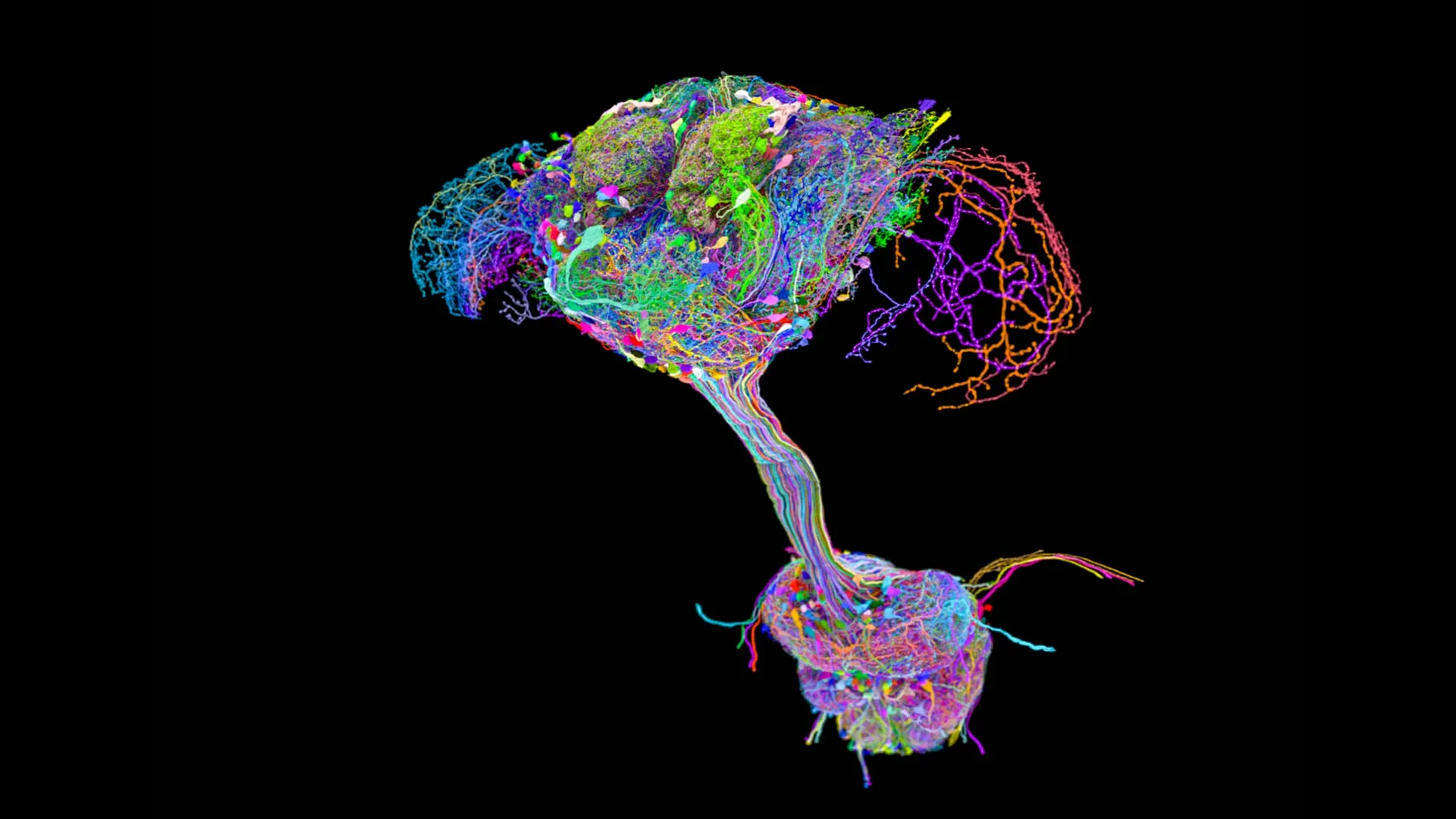
In a landmark achievement for neuroscience, an international consortium of researchers, spearheaded by teams from Harvard Medical School and Princeton University, has unveiled the first comprehensive wiring diagram of the entire central nervous system of an adult fruit fly. This meticulously detailed map, known as a connectome, meticulously traces every neuronal connection within the fly’s brain and its crucial nerve cord, offering an unprecedented glimpse into how an organism’s nervous system orchestrates complex behaviors. The findings, published on June 8th in the prestigious journal Nature, represent a significant leap forward in our understanding of neural circuits and their role in translating sensory input into action.
This groundbreaking work extends previous connectome studies by integrating the fly’s brain with its nerve cord, the equivalent of a spinal cord. For the first time, scientists can visualize and analyze the complete network linking sensory perception, processing, and motor output across the entire central nervous system of a complex organism. This holistic view is critical for understanding the intricate interplay between the brain and body, enabling researchers to probe the fundamental principles governing nervous system function.
The Fruit Fly: A Powerful Model for Neural Exploration
The fruit fly, Drosophila melanogaster, has long been a cornerstone of neuroscience research due to its advantageous characteristics. Despite possessing a relatively small nervous system—comprising approximately 160,000 neurons compared to the human brain’s estimated 86 billion—these tiny insects exhibit a remarkable range of sophisticated behaviors. These include intricate navigation, social interactions, learning, and rapid responses to sensory stimuli. Furthermore, fruit flies offer a highly sophisticated genetic toolkit, allowing scientists to precisely manipulate and monitor the activity of individual neurons or entire neural populations. This genetic tractability, combined with their behavioral complexity, makes them an ideal model organism for unraveling the mysteries of neural computation.
The journey to this complete connectome was a multi-year endeavor involving significant collaborative effort. The FlyWire Consortium, co-led by Professor Mala Murthy and Professor Sebastian Seung at Princeton University, had previously published a complete connectome of the fruit fly brain in 2024. Concurrently, a parallel effort led by Dr. Wei-Chung Allen Lee, an associate professor of neurobiology at Harvard Medical School and a professor of neurology at Boston Children’s Hospital, focused on constructing a connectome of the fruit fly’s nerve cord. This nerve cord is vital for controlling appendages like legs and wings, as well as processing sensory information from the periphery. The integration of these two datasets, brain and nerve cord, was the crucial step that allowed for a unified understanding of the central nervous system.
Dr. Lee emphasized the importance of this integrated approach: "It is really important to have a central nervous system connectome that is as complete as possible so we can link up the brain and body and start thinking about behavior holistically." This sentiment was echoed by co-first author Helen Yang, a research fellow in neurobiology in the Rachel Wilson Lab at Harvard, who stated, "The brain and nerve cord connectomes are each useful on their own, but until you can bridge the two, it’s hard to understand how information moves between the brain and the body."
Alexander Bates, another co-first author and research fellow in neurobiology in the Wilson Lab, highlighted the complementary nature of the two components. While the brain houses the majority of neurons, the nerve cord contains neurons that are particularly valuable for research due to their direct involvement in sensation, movement, and other functions that are often more readily observable and interpretable.
Constructing the Blueprint: A Technological Tour de Force
The creation of this intricate neural map was a monumental undertaking, leveraging cutting-edge imaging and computational techniques. The process began with the painstaking dissection of a single adult fruit fly into thousands of ultrathin serial sections. These sections were then subjected to high-resolution electron microscopy, capturing millions of images that revealed the intricate architecture of neurons and their synaptic connections.
The sheer volume of data generated required sophisticated artificial intelligence (AI) algorithms to process. These AI tools played a crucial role in aligning the vast array of images and reconstructing them into a coherent, three-dimensional model of the entire central nervous system. The resulting connectome depicts every neuron and its connections at the synaptic level, providing an unparalleled level of detail.
While the connectome primarily maps the central nervous system, researchers employed advanced techniques to "embody" it. By referencing identifiable neurons and extensive scientific literature, they were able to link the central nervous system neurons with those in various appendages and sensory organs, effectively extending the map’s functional relevance to the fly’s entire body.
A Paradigm Shift in Understanding Motor Control
One of the most significant revelations emerging from the new connectome concerns motor control. For decades, a prevailing hypothesis in neuroscience posited that the brain acts as a centralized command center, dictating all animal actions. However, the detailed wiring diagram of the fruit fly’s central nervous system suggests a more distributed model.
The researchers discovered that motor control in fruit flies is largely decentralized, with local neural circuits within specific body parts playing a dominant role. For instance, the intricate movements of a single leg are primarily governed by dedicated neural circuits within that leg. These local circuits then communicate and coordinate with circuits controlling other legs to produce synchronized actions, such as walking. This pattern extends to other body parts, including the wings, mouthparts, and other appendages.
"Our findings suggest that control for actions is highly distributed in local modules that link up and work together in different ways," explained Bates. This distributed control allows for efficient and flexible responses to the environment. Furthermore, the study revealed that these motor circuits are intricately interwoven with other neural systems, including the visual and endocrine systems. This integration allows for the incorporation of contextual information, such as sensory input and internal physiological states, which further refines and shapes behavior.
Dr. Wilson, a co-senior author, expressed her excitement about the potential of this new resource: "We can see all of the neurons and their connections as a complete unit for the first time and ask, ‘What do we learn from that?’" The connectome serves as an invaluable tool for generating novel hypotheses, akin to having detailed navigation data when planning a journey. "The connectome has shown us that most of our hypotheses are too simple. Now, we can develop more complex hypotheses and move forward with experiments to test them," Lee added.
Unlocking Future Discoveries: A Resource for Global Neuroscience
The complete fruit fly central nervous system connectome is now freely accessible online through the FlyWire platform (http://codex.flywire.ai/?dataset=banc). This open-access policy ensures that researchers worldwide can leverage this powerful resource to advance their investigations. The publication received substantial support from U.S. federal funding agencies, including the BRAIN Initiative (Brain Research Through Advancing Innovative Neurotechnologies), the National Institutes of Health, and the National Science Foundation, underscoring the national and international commitment to neuroscience research.
The potential applications of this connectome are vast and far-reaching. Researchers anticipate it will catalyze a new wave of studies across numerous fields of neuroscience. Professor Murthy likened the impact of this connectome to that of the Human Genome Project, a monumental undertaking that provided a foundational resource for countless subsequent discoveries in genetics and medicine.
Looking ahead, the research team plans to augment the connectome with additional layers of information, including details about neuropeptides—small, protein-like molecules crucial for neuronal communication. This will provide a more nuanced understanding of how neurons interact and influence each other.
Broader Implications and Future Directions
The principles governing neural organization and function observed in fruit flies are often conserved across species. Many discoveries made in fruit fly neuroscience, ranging from navigation mechanisms to olfactory processing and memory formation, have found parallels in mammals, including humans. Therefore, this comprehensive connectome holds the potential to reveal fundamental rules that apply to nervous systems more broadly.
"I would be shocked if this is unique to the fly," stated Yang, referring to the distributed control mechanisms. "We don’t have this level of resolution in other animals, but we know that they have a lot of these local circuits." The ultimate goal for many in the field is to extend full-connectome mapping to more complex organisms. Advances in AI, computational power, and the growing emphasis on open, collaborative scientific endeavors are making this ambitious goal increasingly attainable. Dr. Lee is already initiating investigations into similar distributed control mechanisms in mouse models, aiming to ascertain the universality of these findings.
Echoes in Artificial Intelligence
Beyond fundamental biological research, the fruit fly connectome offers significant implications for the field of artificial intelligence (AI). The detailed biological data captured in the connectome can serve as a valuable guide for the design of more sophisticated and efficient AI agents. As AI systems become increasingly responsible for navigating complex virtual and real-world environments, understanding how biological brains achieve such feats can inform the development of more robust and adaptable artificial intelligence.
"One thing that always amazes me is that this tiny little fly does a hell of a lot; even our best AI agents and robots can’t do everything that a fly does," observed Yang. "There may be lessons for AI in how the nervous system is organized." The intricate, decentralized architecture of the fruit fly’s nervous system, for instance, could offer new architectural paradigms for AI, potentially leading to more energy-efficient and adaptable artificial systems.
The publication of this complete central nervous system connectome marks a pivotal moment in neuroscience. It not only provides an invaluable resource for the scientific community but also opens new avenues of inquiry into the fundamental mechanisms of brain function, behavior, and the very nature of intelligence itself. The journey from understanding the wiring of a simple fly to potentially unlocking the secrets of complex brains has taken a significant stride forward.