Kang Muslim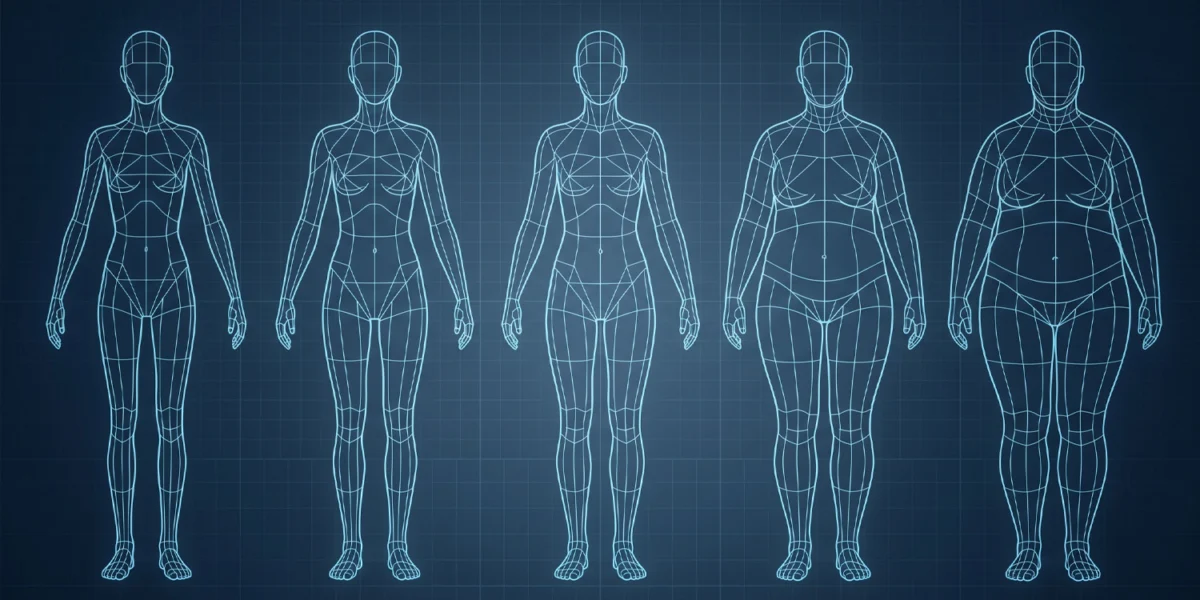
The Cognitive Architecture of Body Perception
For decades, psychologists and neuroscientists have debated how the human brain processes complex objects like the human body. One school of thought, known as holistic processing, suggests that we perceive the body as a single, unified gestalt where the relationship between all parts is processed simultaneously. An alternative theory, parts-based processing, posits that the brain identifies specific, high-information "local" cues to extrapolate a global judgment.
The study by Marinko et al. aimed to resolve these conflicting theories by measuring how specific anatomical regions contribute to the accuracy of size estimation. By isolating different sections of the female form, the researchers were able to track where the visual system’s "information bottlenecks" occur. The results indicate a strong preference for the lower torso and legs, suggesting that the brain treats the lower body as a primary diagnostic tool for determining overall mass and volume.
Methodology and the Bodyline Task
The research was conducted through two distinct experiments involving a total of 215 female participants, primarily healthy young adults. To maintain a controlled environment, the researchers utilized standardized images of female bodies ranging from extremely underweight to extremely overweight. Faces were removed from all stimuli to prevent social or emotional cues from interfering with purely physical size judgments.
In what is known as the "bodyline task," participants were shown images of bodies for only 250 milliseconds—a quarter of a second. This brief exposure is critical in vision science because it prevents the eyes from making multiple "saccades" or movements, forcing the brain to rely on its initial, rapid perceptual processing. After the image vanished, participants rated the size of the body on a scale of one to seven, anchored by images of very thin and very large bodies at either end.
Experiment 1: The Dominance of the Lower Body
The first experiment, involving 99 participants, compared size judgments across three conditions: the whole body, the top half (from the navel to the neck), and the bottom half (from the navel to the feet). The data revealed a striking disparity in accuracy between the upper and lower body.
When viewing only the top half of a body, participants’ ability to distinguish between different sizes plummeted. They exhibited a significant increase in "regression to the mean," a perceptual error where observers judge extreme stimuli (very thin or very large) as being closer to the average than they actually are. Essentially, without the lower body, the brain loses its ability to calibrate size accurately, leading to a "flattening" of perceived differences.
Conversely, when participants viewed only the bottom half of the body, their judgments were nearly identical in accuracy to those made when viewing the whole body. The researchers concluded that the upper body—including the shoulders, chest, and arms—provides redundant or secondary information. The visual system appears to "shortcut" the estimation process by focusing on the hips and thighs.
Experiment 2: The Necessity of Relational Cues
Having established the importance of the lower body, the researchers conducted a second experiment with 116 new participants to determine if a single specific feature, such as the "thigh gap" or the outer curve of the hips, was responsible for this accuracy.
Using digital masks, the team isolated the inner thigh area (the space between the legs) and the outer thigh area (the lateral silhouette of the hips). If the brain functioned via simple local cues, seeing just the inner thigh should have been enough to estimate size. However, the results showed the opposite: when the thighs were fragmented, error rates spiked.
Participants were unable to make accurate judgments when viewing either the inner or outer thigh in isolation. This suggests that while the brain uses a parts-based approach (focusing on the lower body), it requires "relational processing" within that part. To judge size accurately, the brain needs to see the relationship between the inner and outer contours of the leg simultaneously. A single trait, such as hip width, is insufficient without the context of the surrounding anatomy.
Quantifying Perceptual Bias: Regression and Serial Dependence
To reach these conclusions, the researchers analyzed two specific types of visual biases: regression to the mean and serial dependence.
- Regression to the Mean: This is a long-term bias where the brain’s "internal average" of all bodies it has ever seen pulls current judgments toward the center. In this study, when visual information was restricted (as in the upper-body-only trials), this bias became overwhelming. Participants could not see enough detail to override their mental "average," leading them to underestimate large bodies and overestimate small ones.
- Serial Dependence: This is a short-term bias where the judgment of the current image is "pulled" toward the image seen immediately before it. If a participant saw a very thin body and then a medium-sized body, they were likely to rate the medium body as thinner than it actually was.
The study found that both of these biases were minimized when the lower body was visible, proving that the thighs and hips provide the "strongest" signal to the visual cortex, allowing it to overcome these innate mental shortcuts.
Implications for Body Image and Clinical Psychology
The findings have profound implications for the study of body dysmorphic disorder (BDD) and eating disorders. In conditions like anorexia nervosa, individuals often perceive their own bodies—and sometimes the bodies of others—as significantly larger than they are. This study suggests that such distortions may be rooted in a failure of the visual system to correctly integrate lower-body features.
If the brain requires a specific relational view of the thighs to calculate size, any neurological or psychological disruption in how that area is processed could lead to massive errors in self-perception. For instance, if a patient with anorexia over-focuses on a single isolated part (like the inner thigh) without integrating it with the rest of the leg’s geometry, the research suggests their error rate would naturally skyrocket, potentially explaining the "distorted mirror" effect.
Clinical applications could include "retraining" the visual gaze of patients. If therapists can identify where a patient’s visual "bottleneck" is occurring, they might use eye-tracking technology to encourage a more holistic integration of lower-body features, potentially reducing the severity of perceptual distortions.
Limitations and the Role of Gender
The researchers were careful to note several caveats. The study focused exclusively on female participants viewing female bodies. This was an intentional choice to create a homogenous dataset, as societal beauty standards and body types vary significantly by gender.
In many cultures, the idealized female form is often associated with specific lower-body ratios (the "hourglass" figure), whereas the idealized male form often emphasizes the "V-taper"—broad shoulders and a narrow waist. Therefore, it is highly probable that if the study were replicated using male stimuli, the results would shift. The upper body (chest and shoulders) might play a much larger role in size estimation for male forms than it does for female forms.
Furthermore, the use of digital rectangular masks to hide body parts may have inadvertently removed "natural" cues like skin texture, shadows, and depth, which could have contributed to the high error rates in the isolated-thigh trials.
Future Research Directions
The University of Western Australia team suggests that future studies should expand to include male participants and male body stimuli to see if the "lower-body dominance" is a universal human trait or a gender-specific perceptual strategy. Additionally, testing these visual tasks on clinical populations—those currently diagnosed with eating disorders—is a logical next step to confirm if their perceptual errors follow the same patterns observed in healthy participants.
As digital media and social platforms continue to saturate daily life with curated body imagery, understanding the "visual grammar" of how we judge size is more important than ever. This study provides a foundational map of that grammar, proving that when it comes to judging the female form, the brain believes the "thighs have it."
The study, titled "The thighs have it: evidence for the importance of lower body regions in female body size judgments," was authored by Lia Marinko, Briana L. Kennedy, Kei-Kei Koh, Laura Dondzilo, and Jason Bell. It represents a significant step forward in the intersection of vision science and psychological health.