Layla Zulfa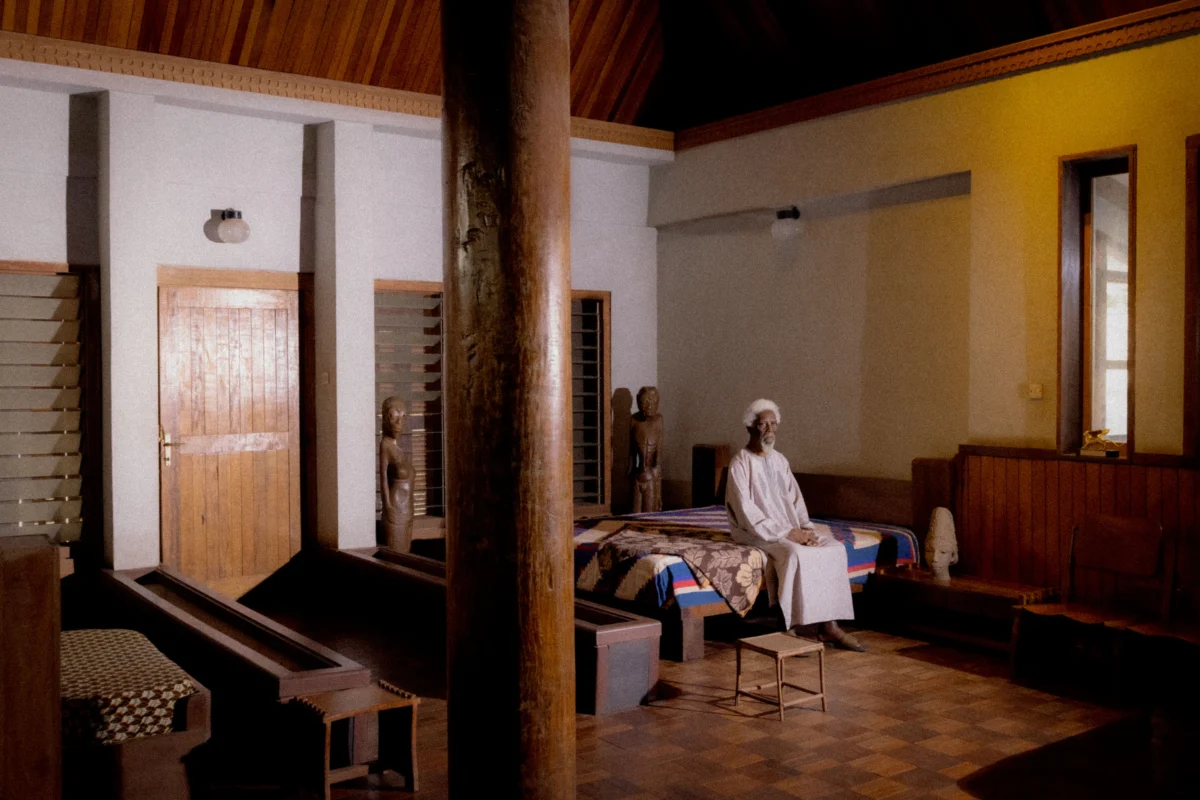
At the age of 90, the Nigerian architect, artist, and polymath Demas Nwoko remains a foundational figure in the evolution of African structural identity, his life’s work standing as a testament to the viability of indigenous materials and the necessity of "natural synthesis" in design. His legacy is most tangibly felt within the walls of his rural sanctuary in Idumuje-Ugboko, a historic town situated in the northern reaches of Nigeria’s Delta State. This residence, built over four decades ago, serves as a living laboratory for Nwoko’s philosophies, which reject the wholesale importation of Western architectural styles in favor of a vernacular modernism that responds directly to the geography and culture of West Africa.

The journey to Nwoko’s estate requires a traverse through a landscape defined by red laterite earth, dense palm groves, and low-canopy trees. In this region, architecture is a direct extension of the soil; houses rise modestly, some finished in refined clay and others left as raw, sunbaked brick and timber. In Idumuje-Ugboko, the aesthetic is one of pride and precision, where carved wooden doors and geometric wall patterns signify a deep-rooted craftsmanship. It is within this context that Nwoko’s home appears, a structure that is neither purely traditional nor conventionally modern, but a sophisticated hybrid of the two.
A Chronology of Creative Evolution
Demas Nwoko was born in 1935 into the royal household of Idumuje-Ugboko, the son of Obi Nwoko II. His upbringing within the palace provided an early immersion into the architectural traditions of the Benin Empire, which historically influenced the Delta region. Unlike the Yorubaland tradition where elaborate palace architecture was reserved for royalty, the Benin style featured domestic applications that Nwoko found deeply resonant.

His formal journey into the arts began in the late 1950s at the Nigerian College of Arts, Science and Technology in Zaria. It was here that Nwoko, alongside peers like Uche Okeke and Bruce Onobrakpeya, formed the Zaria Art Society—later known as the "Zaria Rebels." This group pioneered the philosophy of "Natural Synthesis," an ideological movement that advocated for the merging of traditional African aesthetics with modern Western techniques. While many of his contemporaries focused on painting and sculpture, Nwoko’s interests were inherently pluralistic.
In the 1960s, Nwoko studied theater architecture and set design in Paris, an experience that informed his later work as a lecturer in drama at the University of Ibadan. By the 1970s, his focus shifted toward the physical environment. He realized that the "modern" buildings being erected in post-independence Nigeria were often ill-suited for the tropical climate, relying heavily on energy-intensive air conditioning and imported materials. This realization led to the establishment of the New Culture Studios in Ibadan and, eventually, the construction of his personal residence in 1978.

The Innovation of Laticrete and Material Sovereignty
One of Nwoko’s most significant contributions to sustainable architecture is his development of "laticrete." During the mid-20th century, colonial and post-colonial building regulations in Nigeria often discouraged or outright prohibited the use of local laterite soil for permanent structures, favoring imported Portland cement. Nwoko viewed this as an economic and cultural mistake.
"A building is not viable if it doesn’t make use of local materials," Nwoko has frequently asserted. To circumvent restrictive laws while maintaining structural integrity, he experimented with soil stabilization. By mixing local laterite—the iron-rich red soil of the region—with a minimal percentage of cement, he created laticrete. This material retained the thermal properties of traditional mud-brick—keeping interiors cool in the heat of the day—while providing the durability required for multi-story construction.

His home in Idumuje-Ugboko is clad entirely in these laticrete blocks. The choice was not merely aesthetic but political; it was a demonstration that Nigerian soil was sufficient to build a world-class residence. This focus on material sovereignty has gained renewed relevance in the 21st century as the global construction industry seeks ways to reduce the massive carbon footprint associated with traditional concrete production.
Structural Features: The Impluvium and the Conical Square
The architecture of the Nwoko residence is defined by two primary features that address the environmental challenges of the tropics: the central impluvium and the conical square roof.

The interior of the home is characterized by an open-plan layout, a design choice that facilitates natural ventilation. "That is our way of living: open plan, no rooms," Nwoko explains, noting that the fluidity of the space reflects traditional communal living. At the heart of the house is an indoor courtyard featuring a central impluvium—a fiberglass-lined funnel designed to capture and direct rainwater. In the dry season, the opening provides a source of natural light and serves as a thermal chimney, drawing warm air up and out of the living spaces.
The upper floor of the residence introduces the "conical square," an adaptation of Igbo architectural traditions. This pitched roof is anchored by a single, massive structural pillar at the center, allowing for expansive, column-free spaces at the perimeter. The roof itself is constructed from local timber, laid by Nwoko’s own hands. The steep pitch and deep overhangs serve a dual purpose: they shed the torrential rains of the Delta State while shading the walls from the intense midday sun, significantly reducing the building’s internal temperature without the need for mechanical cooling.
.jpg)
Furnishing and Interior Aesthetics
The interior of the sanctuary is a curated gallery of Nwoko’s life as a "creative pluralist." The furniture, including his signature interlocking wooden chairs, is crafted without the use of metal nails, relying instead on traditional joinery techniques. These pieces are not merely functional but are sculptural objects that mirror the geometric boldness of his architectural facades.
Natural light is kept deliberately low in the living quarters, creating an atmosphere of "sacred silence." This is punctuated by stained-glass panels, a technique Nwoko perfected during his work on the Dominican Chapel in Ibadan—a project often cited as one of the greatest examples of 20th-century religious architecture in Africa. In the dining and lounge areas, his wooden sculptures live in their own designated spaces, their expressive forms carved from solid timber.

Bofu Nwoko Ugbodaga, Nwoko’s daughter and a senior partner at their firm, New Culture Designs, emphasizes that the home has remained largely unchanged since the late 1970s. "It is an ageless building," she says. "Every choice ever made here was intentional." This intentionality extends to the way the building has aged; the laticrete has patinated with the environment, making the house appear as if it grew from the earth rather than being placed upon it.
Broader Impact and Global Recognition
While Nwoko’s work was once seen as a niche pursuit of "traditionalism," it is now recognized as a precursor to the modern sustainable design movement. In 2023, the Venice Biennale of Architecture awarded Demas Nwoko the Golden Lion for Lifetime Achievement. The jury noted that his work represents a "profound understanding of the relationship between culture, geography, and climate."

Supporting data from architectural studies in West Africa suggests that buildings modeled on Nwoko’s principles—utilizing thermal mass and passive cooling—can reduce energy consumption by up to 40% compared to standard glass-and-steel structures in the same climate. His insistence on local labor and materials also ensures that the economic benefits of construction remain within the local community, a model for "circular" architectural economies.
Beyond the physical structures, Nwoko’s influence is felt through his educational efforts. His book on tropical architecture, which he continues to refine at age 90, aims to provide a theoretical framework for future generations of African designers. He remains an active collaborator with younger architects, ensuring that his methods are not lost but adapted to contemporary technological advancements.

The Future of the Nwoko Legacy
The significance of Demas Nwoko’s 90-year journey lies in his refusal to accept the "poverty of imagination" that often accompanies rapid urbanization. As Nigeria’s cities expand at some of the highest rates in the world, the pressure to build quickly and cheaply often results in structures that are environmentally and culturally sterile. Nwoko’s home in Idumuje-Ugboko stands as a rebuttal to this trend.
His recent completion of a new church tower and his ongoing literary projects suggest a man who remains tethered to the future rather than the past. "As long as there is work to do, how do I stop?" he asks. For Nwoko, architecture is not merely a profession but a moral obligation to protect and dignify the human experience within its specific geographic context.

As global architecture moves toward a more "decarbonized" and localized future, the lessons embedded in the red walls of Idumuje-Ugboko are more relevant than ever. Demas Nwoko has proven that by looking deeply into the traditions of the past, one can find the most effective solutions for the challenges of the future. His rural sanctuary remains a beacon of Nigerian modernism—a place where the earth, the hand, and the mind meet in perfect, sustainable harmony.