Ronny Sianturi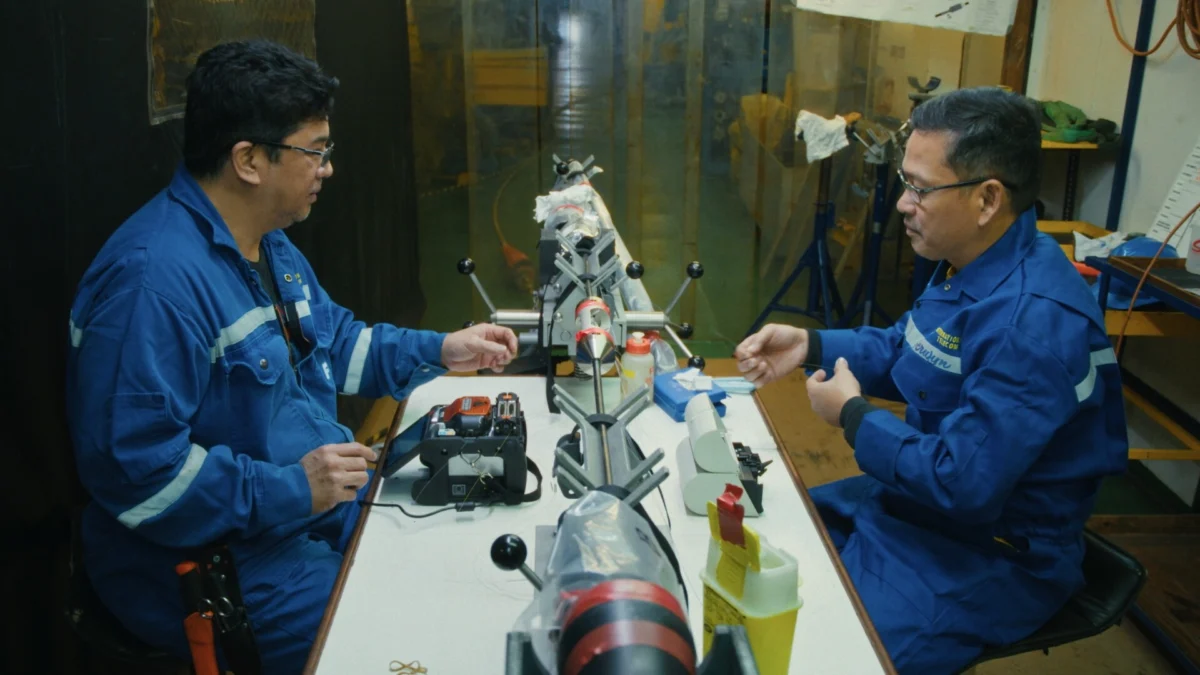
Filmmaker Ian Purnell’s debut feature documentary, Arctic Link, embarks on an ambitious and visually stunning exploration of a monumental undertaking: the laying of vital fiber optic cable to connect a remote corner of Alaska to the global internet. The film, which world premieres on Monday, March 16, in the main competition program of CPH:DOX, the Copenhagen International Documentary Film Festival, offers a profound look at the technological, human, and societal dimensions of this critical infrastructure project. The 23rd edition of CPH:DOX runs through March 22, showcasing a curated selection of groundbreaking documentary cinema.
Arctic Link is more than just a film about connectivity; it’s an epic chronicle of scale and isolation, technological advancement and human endurance. The film’s synopsis starkly illustrates the immense undertaking: “In the Arctic Ocean, a colossal ship drifts along, while thousands of kilometers of fiber optic cable slide from the deck into the dark depths of the sea.” This visual of a ship navigating the unforgiving Arctic waters, meticulously deploying a lifeline of digital communication, forms the powerful centerpiece of Purnell’s narrative.
The creation of Arctic Link was a testament to Purnell’s dedication and patience, spanning approximately ten years from conception to completion. This extensive timeline underscores the complexities involved in documenting a project of such magnitude. The CPH:DOX festival itself highlights the film’s ambitious scope, noting, “Everything is enormous – from the massive cables to the images and phenomenal sound design – but the human scale never disappears from view.” This juxtaposition of the grand technological endeavor with the intimate human experience is a central theme, as the film contrasts the imposing industrial operation with the quiet lives of the Filipino crew members aboard the cable-laying vessel. For these individuals, their mobile phones represent their sole, and sometimes unreliable, connection to loved ones, underscoring the paradox of being at the forefront of global connectivity while experiencing profound isolation.
The Genesis of an Invisible World
Director Ian Purnell’s fascination with the internet’s physical infrastructure began with a simple act of cartography. "When I first discovered a map of the world’s submarine cables, the internet suddenly took on a physical shape," Purnell shared in a director’s statement. "I felt a strong urge to trace these hidden routes – to see how the network disappears beneath the sea and to meet the people who build these connections. I wanted to understand this infrastructure that usually remains unseen, and I knew I could only approach it emotionally rather than purely technologically." This desire to humanize the abstract and visualize the unseen propelled his decade-long pursuit.
The production of Arctic Link was a collaborative effort, with Franziska Sonder serving as producer. The film’s breathtaking cinematography is credited to Marie Zahir, who worked closely with Purnell to capture the stark beauty of the Arctic and the immense scale of the operation. Chris Wright edited the documentary, while Tobias Koch was responsible for the evocative sound design and musical score. Filmotor is handling international sales for the film.
A Decade of Challenges and Perseverance
The journey to bring Arctic Link to the screen was fraught with logistical hurdles and unforeseen delays. Purnell recounted the painstaking process of gaining access to the highly specialized world of submarine cable laying. "I had the original idea more than 10 years ago, and quite early on, I researched where I could get on one of these ships," he explained. "It turned out to be a very difficult exercise to build relationships with these companies and for them to have a reason to take me on."

Several opportunities to board a cable-laying vessel were explored, but each was thwarted by external factors. A powerful storm, the cancellation of a specific cable project, and the global disruption caused by the COVID-19 pandemic all conspired to delay Purnell’s access. "So, gaining access required a huge amount of patience," Purnell concluded, emphasizing the need for him and cinematographer Zahir to remain "extremely flexible" throughout the protracted development process.
Beyond the logistical challenges of boarding a ship, the very nature of shooting in remote, often internet-deprived locations presented its own set of difficulties, particularly in building trust and rapport with local communities. "It was very important just to be present there and make connections in the village," Purnell told The Hollywood Reporter. "It went quite quickly once we were there, but the preparation beforehand was very difficult."
The Human Perspective: Alaskan Islanders and the Digital Dawn
A significant aspect of Arctic Link delves into the perspectives of the Alaskan islanders who are on the cusp of receiving this digital connection. Purnell was struck by their prescient understanding of the internet’s potential impact. "It was a very wise perspective," he observed. "They weren’t innocent. They knew what it was and would bring [with it], but they also could see it from an outside perspective a bit, which is hard when you are ridiculously immersed in it, like us."
The conversations surrounding the arrival of the internet were not forced; they emerged organically from the tangible presence of the cable-laying ship. "Once we got off the ship and came to the island, all these conversations just started to flow," Purnell recalled. "Everyone had this awareness that this ship was bringing the internet. It is a different kind of awareness that a lot of us don’t have, because you don’t see this ship that brings you the internet in front of you. So, these conversations just happened organically. I didn’t want to force my concept on them: ‘Now, talk about the internet!’ So, I was glad that this was just a natural topic of discussion, because they saw it right in front of them, coming towards them." This organic unfolding of dialogue allowed Purnell to capture authentic reactions and reflections from the community.
Visualizing the Invisible: An Aesthetic Approach
The challenge of representing something as intangible as the internet in a visually compelling way was a central artistic pursuit for Purnell and his team. "For me, it was really important to find a new visual connection to the internet," Purnell stated. This meant eschewing the cliché of servers and blinking lights, opting instead for a more evocative and surprising aesthetic. "I was really interested in creating this new imagery that even for me was surprising. In contrast, the ship was built in the ‘80s, before the World Wide Web existed, so we got this smell of oil and this steampunk aesthetic instead of high-tech imagery."
The creative process involved transforming the often-impersonal infrastructure into something with a sense of life and agency. Purnell and cinematographer Zahir engaged in discussions that bordered on the zoological. "We really tried to make inanimate infrastructure feel alive by portraying the cable like a snake, for example," Purnell explained. "We were often talking about what kind of animal something could be, such as a whale. How can we make this physical stuff feel more alive? These discussions helped us make technical things become or function as protagonists, creating a more emotional connection, or sensual connection, rather than just a rational, technical connection." This approach aimed to forge a deeper, more visceral understanding of the network that underpins modern life.
The inherent invisibility of the internet presented a profound filmmaking challenge: "The challenge was to make a film about something that is invisible and create an imagery for it," Purnell told THR. "And the fact that it is invisible also creates different stories around it. Different people who have a connection to it have to use their own imagination, so that creates a multitude of stories."

The Scale of Connectivity: Data and Implications
The film opens with a striking statistic that underscores the critical importance of submarine cables: 99 percent of internet traffic traverses these underwater conduits. This fact alone highlights the fragility of our digital world and the immense scale of the infrastructure required to maintain it. The installation of new cables, as depicted in Arctic Link, is not merely about convenience; it is about ensuring digital equity, economic development, and access to information for communities that have historically been underserved.
The implications of bringing high-speed internet to remote Alaskan communities are far-reaching. Economically, it can foster new business opportunities, enable remote work, and improve access to telehealth services, which are particularly crucial in vast and sparsely populated regions. Educationally, it can provide students with access to a wealth of online resources, bridging the gap between rural and urban learning environments. Socially, it can strengthen community ties by facilitating communication and access to cultural content.
However, as the film and its participants acknowledge, the arrival of the internet also brings challenges. Concerns about the spread of misinformation, the erosion of traditional cultural practices, and the potential for increased social disparities are valid considerations that communities must navigate. The film’s trailer itself probes this duality, posing the question of whether the internet will ultimately prove to be a savior or a beast, a question that resonates deeply with the complex realities of technological adoption in diverse societies.
A Glimpse into the Future: From Deep Seas to Distant Stars
Despite the monumental effort involved in Arctic Link, Purnell is not contemplating a shift to smaller-scale projects. His gaze is already fixed on the vastness of the cosmos. "I have already done some research around topics of astronomy, especially around black holes," he revealed. "What fascinates me is the image of a black hole, because it’s something that is not possible to capture in an image. It’s all at a very early stage. But whether it is the internet or astronomy, I’m really interested in all these signals and waves. So, with a film about outer space, I would be following a similar approach."
This forward-looking statement suggests that Purnell’s artistic drive is rooted in exploring the unseen, the immeasurable, and the fundamental forces that shape our understanding of the universe, whether they lie in the silent depths of the ocean or the farthest reaches of space. His directorial journey, marked by the ambitious undertaking of Arctic Link, promises further cinematic explorations into the profound and often invisible connections that define human existence. The film’s premiere at CPH:DOX marks a significant moment, offering audiences a rare and compelling insight into a world that silently powers our modern lives.