
 Ronny Sianturi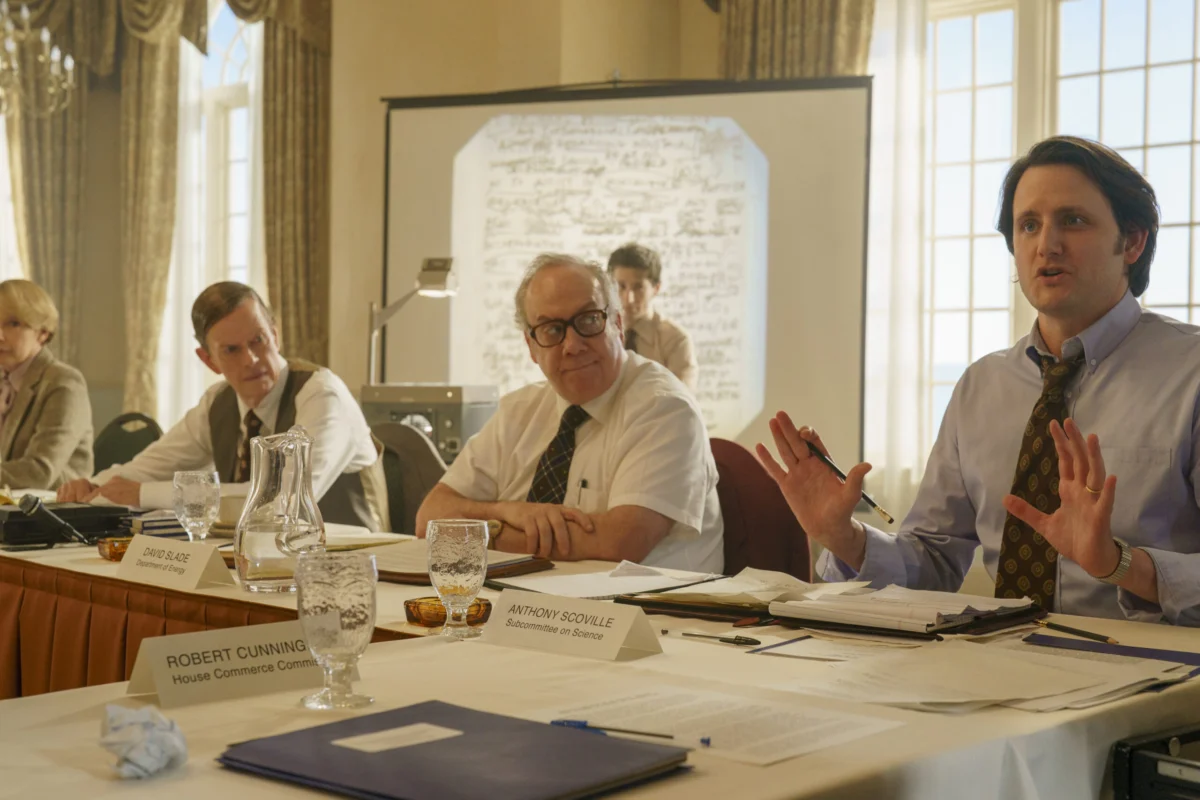
The historical friction between scientific consensus and bureaucratic inertia takes center stage in Tom McCarthy’s latest feature film, A Statement. Premiering at the New York Film Festival, the 107-minute drama reimagines a pivotal 36-hour gathering held in 1980 inside the Don CeSar Hotel in St. Petersburg, Florida. Adapted from a chapter in Nathaniel Rich’s acclaimed 2019 book Losing Earth: A Recent History and incorporating verbatim transcripts, the film examines the frustrations of twenty scientists, environmental activists, bureaucrats, academics, and policymakers tasked with drafting a foundational governmental statement on global warming.
Despite arriving decades before modern climate catastrophes and soaring global carbon dioxide emissions, the characters in A Statement grapple with many of the same political and economic roadblocks that continue to stall international climate policy today. Backed by a high-profile ensemble cast that includes Paul Rudd, Paul Giamatti, Evan Peters, John Turturro, and Tatiana Maslany, the film translates wonkish legislative debate into a visually dynamic and psychologically complex cinematic experience.
The Genesis of a Stalled Consensus: Background and Historical Context
The events depicted in A Statement unfold against the backdrop of a shifting political landscape in late 1970s and early 1980s America. The Carter administration had recently commissioned studies into the long-term environmental hazards of burning fossil fuels, prompting Congress to assemble a diverse advisory panel. Their mandate was seemingly straightforward yet profoundly complex: evaluate emerging data regarding the greenhouse effect and draft an official statement outlining how the United States government should address the unfolding ecological threat.
However, the historical reality of that gathering was fraught with institutional skepticism and a lack of urgency. In 1980, climate change was not yet a deeply entrenched partisan battleground in the way it is today, but the fundamental friction between economic growth and environmental preservation was already firmly established. The presence of a representative from fossil fuel giant Exxon at the conference underscored the nascent, outsize influence that the energy sector would wield over environmental policy for decades to follow.
As the film illustrates through its meticulous adherence to historical records, the panel ultimately dissolved without producing a cohesive statement. This collective failure serves as a sobering historical prologue to the modern climate crisis, illustrating how early opportunities to establish decisive mitigation strategies were lost to endless debate, bureaucratic foot-dragging, and scientific uncertainty.
A Chronology of Bureaucratic Stalemate
Structured almost like a stage play due to its confined setting, A Statement tracks the 36-hour marathon of negotiations in near-real-time. The narrative unfolds through distinct phases of mounting tension:
- The Opening Hours (Day One): The participants arrive at the imposing pink-palace hotel on the Florida coast with vastly disparate expectations. Moderator Tom Jorling, portrayed by Paul Rudd, attempts to establish ground rules and guide the room toward a productive synthesis of the available data. Early optimism quickly gives way to ideological friction as participants debate the very definition of the crisis.
- Deepening Divisions (Day One Evening): Government officials, led by cynical Energy Department representative David Slade (Paul Giamatti), push back against calls for immediate regulatory action. Slade argues that American carbon emissions pale in comparison to those of other continents and questions the reliability of predictive climate models. Meanwhile, atmospheric scientists and activists like Rafe Pomerance (Evan Peters) express mounting frustration at the complacency of their peers.
- The Breakdowns and Interludes (Day Two): As formal talks repeatedly stall, characters retreat to the margins of the hotel, where informal conversations reveal deeper anxieties. A notable interlude finds several delegates crashing a downstairs wedding, providing a brief humanizing respite before returning to the grueling legislative trench warfare.
- The Final Hours and Dissolution: As time runs out on the second day, public health official Annemarie Crocetti (Amy Ryan) makes an impassioned plea to reframe the climate debate as an immediate human crisis rather than a distant mathematical abstraction. Despite moments of rare alignment—such as unexpected agreements regarding nuclear energy—the conference ultimately fractures over irreconcilable policy disagreements, concluding without the mandated statement.
Ensemble Performances and Character Dynamics
While the narrative is anchored by dry scientific data and legislative transcripts, the emotional weight of A Statement is carried by its extensive ensemble cast. Director Tom McCarthy, utilizing the same methodical, investigative rigor he brought to the Academy Award-winning film Spotlight, allows each actor space to develop distinct, sharply defined characterizations.
Paul Rudd anchors the film with a grounded, empathetic performance as Tom Jorling, whose exhaustion mirrors the audience’s growing realization of the meeting’s futility. Paul Giamatti brings sharp cynicism and pragmatic resistance to his role as David Slade, representing the institutional hurdles that have historically hindered government intervention. Evan Peters delivers a fiery, simmering performance as environmental activist Rafe Pomerance, capturing the righteous indignation of those who recognized the existential threat early on.
Adding intellectual wit to the proceedings are John Turturro as MIT nuclear engineer Dr. David Rose—who draws historical parallels between modern society and ancient civilizations that ignored environmental warnings—and Jason Clarke as meteorologist John Perry. Perry’s blithe assertion that humanity has a century to adapt and that coastal populations can simply be relocated to landlocked states serves as a chilling reminder of early scientific hubris.
The gender dynamics of the conference are also central to the film’s narrative arc. Tatiana Maslany portrays legal scholar Edith Brown Weiss, whose exasperation with the lack of a structured agenda highlights the chaotic nature of the proceedings. Amy Ryan delivers an electrifying performance as public health official Annemarie Crocetti, whose late-stage intervention forces the room to confront the human cost of environmental inaction. Nina Arianda rounds out the central cast as Bernadette, a stenographer whose initial professional detachment slowly gives way to deep concern as she absorbs the gravity of the debates playing out around her.
Supporting Data and Broader Implications
The thematic resonance of A Statement extends far beyond its historical 1980 setting. The scientific projections discussed by the characters during the conference—including estimates of atmospheric carbon accumulation and the resultant global temperature increases—largely align with the trajectories that modern climatology has since confirmed.
According to data from the National Oceanic and Atmospheric Administration (NOAA) and the Intergovernmental Panel on Climate Change (IPCC), global atmospheric carbon dioxide concentrations have risen steadily over the past four decades, surpassing 420 parts per million in recent years. Despite exponential growth in renewable energy sectors such as solar and wind, global emissions continue to reach record highs, underscoring the enduring relevance of the policy paralysis depicted in McCarthy’s film.
Financial analysts and environmental policy experts note that the reluctance to implement decisive mitigation strategies during the late 20th century significantly increased the long-term economic and infrastructural costs of climate adaptation. The debate captured in the Don CeSar Hotel conference room—weighing the immediate cost of economic regulation against the delayed, catastrophic expenses of ecological collapse—remains the central dilemma of modern international climate summits such as the United Nations Climate Change Conferences (COP).
Critical Reception and Industry Outlook
Cinematically, critics have praised A Statement for its intellectual rigor and its ability to maintain dramatic tension within a single, dialogue-heavy location. Enhanced by Stuart Dryburgh’s nimble cinematography, which captures the claustrophobic intensity of the conference room, and Bryce Dessner’s pensive musical score, the film stands as a masterclass in procedural drama.
While some viewers may question the narrative utility of a film that chronicles an explicit failure, cultural commentators argue that the conclusion is precisely its most powerful asset. By refusing to offer a neat, Hollywood resolution to an ongoing global crisis, A Statement forces audiences to confront the historical roots of contemporary inaction. As global temperatures continue to break historical records and international policymakers struggle to achieve binding consensus, McCarthy’s film serves as both a historical autopsy of missed opportunities and an urgent reminder of the cost of delay.








