Jono Maryono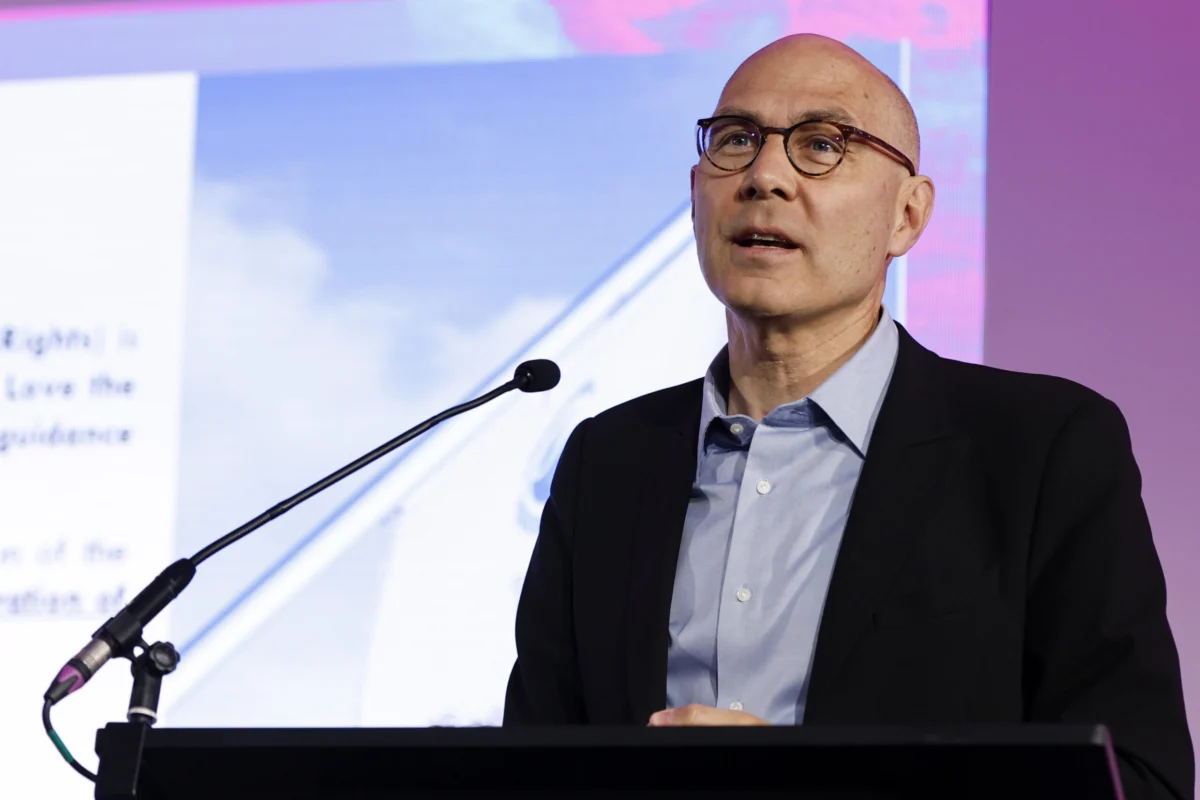
Volker Türk, the incumbent United Nations High Commissioner for Human Rights, has been re-elected to a second four-year term, a significant achievement as he becomes the first individual to hold the post for two complete mandates since its inception in 1993. The vote by UN member states on Friday resulted in a decisive 144-10 outcome, with 13 abstentions, securing his continued leadership of the Office of the High Commissioner for Human Rights (OHCHR). This reappointment, however, was not without considerable controversy, revealing deep fissures within the international community regarding human rights discourse and enforcement.
Türk, an Austrian lawyer with an extensive career within the UN system, particularly with the UN Refugee Agency (UNHCR), has been a prominent and often outspoken figure in global human rights advocacy. His tenure has been marked by a consistent emphasis on accountability for alleged violations, a stance that has drawn both praise and sharp criticism from various member states. His second term is set to commence immediately following the expiration of his current mandate on October 11.
The re-election of Volker Türk marks a historical milestone for the OHCHR. Prior to this, no High Commissioner had managed to secure two full, consecutive four-year terms. The establishment of the OHCHR in 1993 was a response to the growing global recognition of the need for a dedicated, high-level UN mechanism to promote and protect human rights worldwide. The role has since become a critical, albeit often politically charged, platform for monitoring, reporting, and advocating on human rights issues across the globe. Türk’s ability to garner broad support, despite vocal opposition from a significant bloc of nations, underscores the complex geopolitical landscape in which the UN human rights apparatus operates.
A Mandate Defined by Strong Stances and International Scrutiny
Since assuming office in September 2022, High Commissioner Türk has consistently adopted a principled and often critical approach to human rights situations. His office has issued numerous reports and statements addressing violations in diverse contexts, ranging from armed conflicts to systemic discrimination. Notably, his vocal criticisms concerning the actions of Israel in Gaza and the broader occupied Palestinian territories have been a defining feature of his tenure, leading to strong reactions from Israel and its allies.
Türk has repeatedly called for adherence to international humanitarian law, urging all parties to conflicts to uphold their obligations and ensure accountability for any breaches. His office has documented alleged atrocities and human rights abuses, often highlighting the disproportionate impact on civilian populations, particularly women and children. This has included detailed investigations and public statements regarding the situation in Gaza, where the OHCHR has been at the forefront of documenting alleged violations by all parties involved in the ongoing conflict.
The Vote and Its Immediate Aftermath
The vote on Türk’s reappointment took place under circumstances that some observers have described as expedited. UN Secretary-General António Guterres reportedly informed regional groups of his intention to reappoint Türk earlier in the month, with the vote following shortly thereafter. This timing, according to critics, did not allow for sufficient deliberation and debate among member states.
The outcome of the vote—144 in favor, 10 against, and 13 abstentions—demonstrates a substantial majority in support of Türk’s continuation. However, the opposition, though numerically smaller, represents influential global powers. Among the nations that voted against his re-election were the United States, Israel, and Russia, alongside North Korea and six other states. The abstaining countries represent a further layer of nuanced positions within the UN General Assembly.
Following the announcement of his re-election, Volker Türk expressed his gratitude, stating on social media, "I am deeply grateful to be re-elected. Human rights are the antidote to today’s turbulence and defeatism. I will give my all for the rights of everyone, everywhere." This statement reflects his core commitment to the universal application of human rights principles.
Divergent Perspectives: Accusations and Defenses
The opposition to Volker Türk’s re-election stems from significant disagreements over his approach and the perceived neutrality of the OHCHR under his leadership. Israel, in particular, has been a vocal critic, accusing the High Commissioner’s office of bias and a departure from UN principles.
The Israeli Ministry of Foreign Affairs released a statement detailing its objections, asserting that under Türk’s leadership, the OHCHR has "erased the atrocities of October 7, misused funds, and betrayed UN neutrality in favor of corrupt political radicalism." This accusation points to a fundamental disagreement over how the OHCHR has framed and investigated events related to the Israeli-Palestinian conflict. Israel contends that the office has failed to adequately acknowledge the attacks it endured and has instead focused disproportionately on alleged Israeli wrongdoings.
The United States, a key ally of Israel, also voiced strong disapproval of the process and the outcome. Jeff Bartos, the US representative for UN Management and Reform, characterized the vote as a sign of the UN human rights system’s declining credibility. He stated that Türk "led it to its deathbed" and that the vote "kicked the bucket." The US Department of State further elaborated on this sentiment, calling the vote "another example of the UN’s inherent corruption and incompetence," and accusing Türk of having "turned a blind eye to real atrocities and instead pursued a radical ideological agenda." This suggests a fundamental divergence in how the US perceives the role of the UN human rights chief and the nature of current global human rights challenges.
Conversely, the European Union’s delegation at the UN welcomed Türk’s reappointment, expressing anticipation for continued collaboration with his office to "promote and protect human rights worldwide." This response highlights the broad support for Türk’s mandate among a significant bloc of UN member states, indicating a divide between European nations and some of the world’s leading powers.
Background and Context: The Evolution of the High Commissioner Role
The position of the UN High Commissioner for Human Rights was established by the UN General Assembly in December 1993, with the aim of enhancing the UN’s overall human rights program. The first High Commissioner, José Ayala Lasso of Ecuador, took office in 1994. The role was envisioned as a high-profile advocate, working to ensure that human rights are given the attention and the commitment they deserve.
Over the past three decades, the OHCHR has evolved into a significant entity, with a mandate to:
- Promote and protect human rights: This involves advising governments, supporting national human rights institutions, and engaging in public awareness campaigns.
- Respond to gross violations: The office investigates and reports on situations of widespread human rights abuses, often in collaboration with special rapporteurs and independent experts.
- Enhance international cooperation: The High Commissioner acts as a liaison between the UN human rights mechanisms and other international bodies.
The High Commissioner is appointed by the Secretary-General, subject to the approval of the General Assembly. This process, as demonstrated by Türk’s re-election, can become a focal point for geopolitical tensions, with member states leveraging the vote to express their foreign policy positions and ideological alignments.
Analysis of Implications: A Divided Consensus on Human Rights
Volker Türk’s re-election for a second term, while a personal and institutional success in securing continuity, also amplifies the existing divisions within the international community on human rights. The significant opposition from powerful nations like the United States and Russia, alongside Israel, suggests a deepening divergence in how human rights are defined, prioritized, and enforced on the global stage.
The criticism leveled against Türk by these nations points to a broader debate about the OHCHR’s mandate and its perceived impartiality. For countries that face international scrutiny for their human rights records, the High Commissioner’s office can be seen as a politically motivated entity rather than an objective arbiter. The accusations of bias and "radical ideological agendas" reflect a resistance to the universal application of human rights principles when they challenge national interests or political narratives.
The fact that Türk is the first to achieve two full terms indicates a level of trust and support from a substantial majority of UN member states. This broad support can empower the OHCHR to continue its work, albeit within a context of heightened scrutiny and potential obstruction from dissenting states. The challenge for Türk in his second term will be to navigate these divisions, maintain the credibility of his office, and continue to advocate for human rights in an increasingly complex and polarized world.
The US representative’s comments about the UN human rights system "losing credibility" and the vote being a symbolic "deathblow" suggest a potential for increased disengagement or a re-evaluation of the US’s role within these multilateral frameworks. Conversely, the EU’s endorsement signals continued commitment to the UN’s human rights architecture.
The controversy surrounding the vote’s timing also raises questions about transparency and due process within UN appointments. The perception of an "expedited" process can fuel skepticism and further entrench opposition, particularly from states that feel their concerns are not being adequately addressed.
Ultimately, Volker Türk’s re-election is a testament to the enduring importance of the High Commissioner’s role, even as it highlights the profound challenges in achieving a unified global consensus on human rights. His second term will undoubtedly be closely watched, as he seeks to uphold the principles of human dignity and accountability in the face of significant international discord. The coming years will likely see continued debate over the OHCHR’s effectiveness, its perceived neutrality, and its capacity to influence human rights outcomes in a world grappling with persistent conflict and political division. His career, spanning decades within UNHCR and now leading the OHCHR, underscores a deep-seated commitment to refugee protection and human rights advocacy, a dedication that will continue to shape his work on the global stage.