Ana Megawati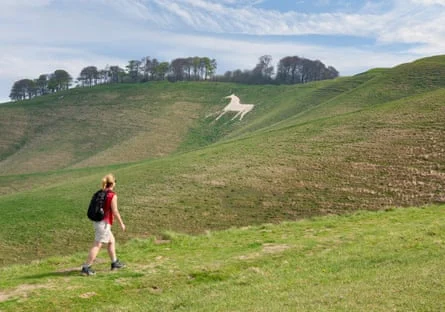
England’s rolling chalk downs, particularly those stretching across the south, serve as a vast, ancient canvas for an extraordinary collection of monumental artworks: the enigmatic chalk hill figures. These carvings, etched into the landscape for millennia, range from prehistoric horses and mysterious humanoids to more recent regimental symbols and royal tributes. They represent a unique and enduring aspect of the nation’s cultural heritage, drawing pilgrims, artists, historians, and casual wanderers alike into their captivating narratives. A recent exploration, chronicled in "The Tattooed Hills" by Jon Woolcott, delves into the stories and landscapes surrounding these captivating figures, revealing their profound impact on England’s identity and imagination.
The Sentinels of the South Downs: Wilmington’s Long Man and Litlington’s Horse
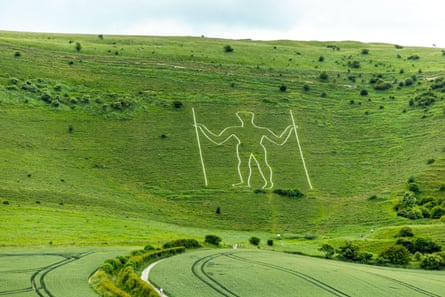
The journey into this chalk-etched world often begins in East Sussex, near the venerable Wilmington Priory. Here, the landscape presents a stark contrast between the ancient and the eerily preserved. The churchyard hosts a yew tree of immense antiquity, its stooped trunk having consumed part of a gravestone, its boughs shored up by poles – a sight imbued with a folk-horror aesthetic. Yet, the true focus of curiosity lies across the valley on the steep scarp of the South Downs: the colossal figure of the Long Man of Wilmington.
This impressive anthropomorphic figure, measuring 72 meters (approximately 235 feet) in height, appears to trek across the hillside, a stave clasped firmly in each hand. Originally conceived as a chalk giant, his defining lines have, in modern times, been reinforced with concrete blocks. This intervention, undertaken in the 1960s to combat erosion and maintain his form, has sparked debate among purists regarding the authenticity of his appearance, moving him from a purely organic chalk outline to a more permanent, yet altered, structure.
The origins of the Long Man are hotly contested, shrouded in academic debate and local folklore. One prominent theory, championed by archaeologists such as Sonia Chadwick Hawkes following the discovery of a buckle in Kent in 1964, suggests an Anglo-Saxon provenance. The buckle’s design, believed to depict the Norse god Odin (or Woden), shares stylistic similarities with the Long Man, implying a potential connection to pre-Christian Germanic mythology and placing his creation possibly between the 6th and 9th centuries AD. Conversely, some historians argue for a much later date, positing him as a fanciful adornment carved in the 16th or 17th century, perhaps intended to be viewed from the priory below. Without definitive archaeological evidence from his initial carving, the precise dating remains elusive, contributing to his enduring mystique.
Despite the ambiguity of his birth, the Long Man’s presence has left an indelible mark on cultural figures throughout the centuries. The surrealist photographer Lee Miller and her husband, the artist Roland Penrose, who resided nearby at Farleys House, were particularly entranced. Penrose famously painted a surrealist representation of the Long Man on his inglenook fireplace, considering the figure a powerful, protective spirit. His influence extended to the renowned Black composer Avril Coleridge-Taylor, the contemporary folk collective The Memory Band, and even inspired legendary composer Benjamin Britten, who reportedly picnicked at its feet, drawing inspiration from its silent grandeur.
A short distance east, the journey continues to the more secluded Litlington White Horse. Unlike its giant neighbor, this smaller, more intimate figure gazes towards the English Channel near Cuckmere Haven. Its creation in 1924 holds a unique narrative: local people, in an act of community spirit and clandestine artistry, cut the horse secretly in a single night. This modern carving was a successor to an earlier, lost figure, a testament to the continuous human impulse to mark and define the landscape. The Litlington Horse, while lacking the ancient pedigree of some of its counterparts, embodies the ongoing tradition of hill figure creation and the deep connection local communities feel to these land-based expressions. Its lonely vigil over the coast makes it a poignant symbol of a quietly preserved heritage, maintained by dedicated local volunteers who periodically scour its lines to keep it visible against the encroaching turf.

Dorset’s Dramatic Duo: The Royal Ride and the Enigmatic Giant
Venturing west into Dorset reveals another pair of striking hill figures, each with distinct historical and cultural resonances. Perched majestically above Weymouth, overlooking the resort town favored by King George III, is the enormous figure of the monarch himself, astride his beloved horse, Adonis. Carved in 1808, this impressive equestrian monument served a dual purpose: a grand tribute to the reigning king, who made Weymouth a fashionable destination, and a colossal advertisement for the town’s burgeoning popularity. While time and erosion have somewhat faded his once-sharp lines, the figure remains a significant historical marker, representing a direct and public declaration of loyalty and civic pride from a bygone era. Its strategic placement ensured it was visible to ships entering the harbor, solidifying its role as both a landmark and a welcoming beacon.
Further north along the ancient Wessex Ridgeway, the landscape takes a more primal, even menacing, turn with the appearance of the Cerne Giant. Dominating a secluded valley on an opposite hillside, this colossal, priapic figure stands with a club held aloft, an undeniably potent and controversial image. Measuring 55 meters (180 feet) high, the Cerne Giant is arguably the most enigmatic and debated of all English hill figures.
His date of origin has been fiercely contested for centuries, oscillating between vastly different historical periods. Initially, many believed him to be a Romano-British figure, possibly depicting Hercules, due to stylistic similarities with Roman art and the presence of a Roman villa nearby. However, the first documented reference to the giant only appears in parish records from 1694, leading some to suggest a much later, 17th-century creation, perhaps as a satirical caricature of Oliver Cromwell. Other theories have linked him to pagan deities like Helith, a fertility god whose worship might have persisted in remote areas. More recent archaeological investigations, employing optically stimulated luminescence (OSL) dating of soil samples from his elbows and feet, have largely pointed towards an Anglo-Saxon origin, possibly between 700 and 1100 AD. This dating places him firmly within the early medieval period, suggesting he may have represented a Saxon god, hero, or local saint, possibly Eadwold. The ongoing scientific efforts aim to resolve these long-standing debates, yet the giant retains his reputation as an "unreliable shapeshifter," a cultural "joker" whose meaning and purpose have continuously transformed across generations. The National Trust, which owns and maintains the site, has spearheaded these dating projects and ongoing conservation efforts, recognizing the figure’s profound national significance.
Wiltshire’s Galloping Canvas: White Horses of the Ridgeway
Wiltshire, often referred to as "the county of white horses," boasts a remarkable concentration of these iconic chalk figures, with eight still gracing its undulating hills. Following the ancient Ridgeway across these chalklands immerses one in a landscape rich with history and mystery.
A walk along the Wansdyke, a formidable defensive ditch and bank stretching for miles through serene countryside, offers panoramic views of the prehistoric Silbury Hill – Europe’s largest prehistoric man-made mound. This route leads to two prominent equine figures: the Alton Barnes White Horse and the Cherhill White Horse. The Alton Barnes horse, a slim and elegant form, dates back to 1812, carved by a local farmer, John Thorne, who was inspired by the nearby Pewsey White Horse. Its existence is a testament to the continued tradition of landscape artistry well into the Georgian era.
The Cherhill White Horse, carved earlier in 1780 by Dr. Christopher Alsop, a local physician, gallops over a deep-sided coomb, overlooked by an Iron Age hillfort and dramatically signposted by the Lansdowne Monument. This monument, erected in 1845, adds another layer of historical intrigue to the already ancient hillscape, contributing to an atmosphere that can feel both grand and unsettling.
These Wiltshire horses have not only inspired ancient wayfarers but have also found their way into modern popular culture. The Alton Barnes horse made a brief but memorable appearance in the music video for Britpop band Dodgy’s 1996 hit single "Staying Out for the Summer." The video cleverly mashed together nostalgic clichés of the era – VW camper vans, space hoppers, crop circles, and football tops – to evoke a specific, idealized vision of the English countryside. While presenting a rural idyll, it also subtly alluded to the counter-cultural undercurrents of the time, such as raves, albeit without fully embracing the rebellious spirit they represented.
The Cherhill horse, in turn, featured prominently in the video for The KLF’s notorious 1988 novelty hit, "Doctorin’ the Tardis." While perhaps not a musical masterpiece, the video, with its distinctive imagery and the KLF’s characteristic "art-terrorist" antics, cemented the horse’s place in the canon of British pop culture. The KLF’s aesthetic often involved juxtaposing the mundane with the surreal, and their use of the Cherhill horse effectively integrated it into a "dustier landscape," aligning with the quirky and often unsettling character of this corner of Wiltshire. These modern cultural appropriations underscore the enduring power of these ancient symbols to resonate with new generations and diverse artistic expressions.
The Ancient Masterpiece: Uffington’s Timeless Steed
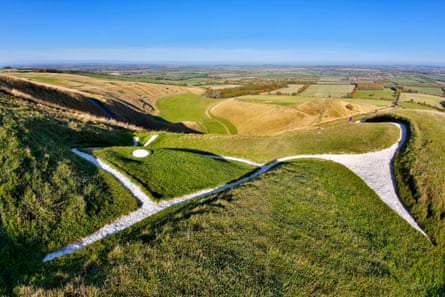
Further along the ancient Ridgeway, straddling the border of Oxfordshire and Berkshire, lies arguably the greatest and most mysterious of all English hill figures: the commanding Uffington White Horse. This highly stylized, elongated equine form, etched into the chalk beneath an imposing Iron Age hillfort, possesses an extraordinary antiquity that sets it apart. Archaeological dating, primarily through optically stimulated luminescence (OSL) analysis conducted in the 1990s, has placed its creation firmly in the late Bronze Age, approximately 3,000 years ago. This makes it by far the oldest known hill figure in Britain, a testament to the sophisticated artistic and engineering capabilities of its creators.
The Uffington White Horse is more than just a carving; it is an extraordinary survival, a living link to prehistoric Britain. For countless generations, local communities have meticulously cared for this "racing animal," undertaking regular "scourings" to clear away encroaching turf and maintain its brilliant white outline. This continuous tradition of communal maintenance highlights the deep cultural significance and reverence afforded to the figure, ensuring its perpetual presence on its wind-blown hill. The specific, almost abstract, design of the Uffington horse—its disjointed limbs and bird-like head—suggests a symbolic rather than realistic representation, possibly connected to spiritual beliefs, tribal identity, or astronomical alignments of the Bronze Age.
Its profound age and unique aesthetic have made it a perennial source of inspiration for artists across various disciplines. The iconic music video for Kate Bush’s 1985 single "Cloudbusting," a haunting narrative about Wilhelm Reich and his "cloudbuster" machine, was filmed on White Horse Hill, with the horse providing a dramatic and ancient backdrop. Similarly, the English new wave band XTC, known for their distinctive, pastoral sound, featured the Uffington White Horse prominently on the cover of their seminal 1982 album, "English Settlement." Andy Partridge, XTC’s frontman, has often spoken about the profound influence of the landscape surrounding his native Swindon on his creative output. He famously stated, "It marked me like an Avebury stone or the ripples across a hillfort. It made me," articulating the deep, almost spiritual connection many feel to these ancient, sculpted landscapes. The Uffington White Horse stands not merely as a historical artifact, but as a vibrant, living monument that continues to shape identity and inspire creativity in the modern age.
Chilterns’ Cryptic Carvings: Crosses, Marks, and Lions
The Ridgeway’s journey north eventually intertwines with the Icknield Way, another ancient track that traverses the country’s chalk spine, leading into the leafy Chiltern Hills. This region harbors a cluster of chalk figures that are distinct in their forms and motivations, ranging from religious symbols to architectural illusions and even corporate branding.
Among these is the Whiteleaf Cross, a prominent religious carving located on Whiteleaf Hill. Unique for its setting, the cross sits atop a massive chalk pyramid, an unusual and striking landscape feature. The exact date of its carving is uncertain, with theories ranging from Saxon origins to a more probable 18th-century creation. Its presence suggests a historical association with Christian worship or commemoration, perhaps marking a significant event or simply serving as a devotional landmark visible across the valley.
Nearby, the Watlington White Mark presents a fascinating example of deliberate landscape artistry and optical illusion. Often misinterpreted as an ancient fertility symbol due to its abstract shape, this figure is, in fact, an 18th-century trompe l’oeil. Local folklore claims that when viewed from a specific vantage point in the valley below, the chalk obelisk miraculously aligns to give the parish church a spire, a clever piece of landscape design intended to enhance the aesthetic appeal of the estate from a particular perspective. This figure highlights the diverse reasons behind the creation of chalk figures, moving beyond purely symbolic or commemorative purposes to embrace architectural and visual trickery.
Further along the Icknield Way, towards Ivinghoe Beacon, a prominent viewpoint offering glimpses of the prime ministerial retreat of Chequers, a more contemporary chalk figure commands attention: the Whipsnade White Lion. Carved between 1931 and 1933, this magnificent lion, measuring 147 meters (482 feet) long, was created to celebrate the opening of Whipsnade Zoo, the country’s first open-air safari park. It serves as a striking symbol of the zoo’s commitment to wildlife conservation and its distinctive landscape. The lion is maintained not only by human volunteers but also, quite remarkably, by the zoo’s resident wallabies, whose grazing helps keep the chalk lines clear of encroaching vegetation. The Whipsnade Lion stands as a testament to the enduring appeal of chalk figures as powerful visual statements, adapted for modern purposes like institutional branding and public engagement.
Lost Legacies and Enduring Quests: The Gog Magog Hills
The journey through England’s chalk figures culminates near the far eastern end of the Icknield Way, in the Gog Magog Hills near Wandlebury, Cambridgeshire. These hills are named after the giants of British folklore who, according to legend, once ruled the land. This site became a focal point for the controversial archaeologist T.C. Lethbridge, who, in the mid-20th century, theorized the existence of numerous prehistoric hill figures hidden beneath the turf, including a goddess and other mythical creatures. While Lethbridge’s findings were largely speculative and lacked definitive archaeological corroboration, with nothing tangible remaining of his purported discoveries, his work nevertheless underscored the deep-seated belief in the landscape’s hidden secrets and the pervasive influence of folklore on archaeological interpretation.
Despite the unproven nature of Lethbridge’s specific claims, the Wandlebury site itself remains a rich tapestry of ancient history. The Iron Age hillfort above, the serene beechwoods, and the nearby ancient trackways embody the essence of the chalklands, condensing millennia of human activity into one country park. It is a place where the visible past meets the imagined, and where the human desire to decipher the landscape’s whispers remains strong.
Lethbridge’s broader sentiment, however, resonates deeply with the spirit of exploring England’s chalk figures. As he wrote in his book describing the dig, a sentiment echoed by Jon Woolcott in his own journeys: "There is no need to go to the ends of the earth for interesting quests and excitement. It is here, in prosaic old England, at one’s back door." This quote encapsulates the profound truth that adventure, mystery, and deep historical connection are not confined to distant lands but are readily accessible within the familiar contours of one’s own country, waiting to be discovered and re-interpreted.
Guardians of the Landscape: Preservation and Future Implications
The preservation of England’s chalk figures is a continuous and collaborative effort, involving national heritage organizations like the National Trust and English Heritage, alongside numerous local community groups and volunteers. These figures are constantly threatened by natural erosion, vegetation growth, and occasionally, human interference. Regular ‘scourings’—the meticulous clearing of grass and weeds to expose the chalk—are vital to their survival, often involving hundreds of volunteers who dedicate their time to maintaining these national treasures.
The implications of these figures extend beyond their historical and artistic value. They serve as potent symbols of local identity, drawing tourists and contributing significantly to regional economies. They also foster a deeper appreciation for England’s natural landscapes and the ancient human connection to them. The ongoing debates surrounding their origins, dating, and restoration methods highlight the dynamic nature of heritage management, balancing historical authenticity with practical conservation needs. The use of modern archaeological techniques, such as OSL dating, continually refines our understanding, adding new layers to their complex narratives.
Ultimately, England’s chalk figures are more than mere carvings on a hillside; they are enduring cultural touchstones. They are monuments to human creativity, belief systems, and historical events, stretching from the Bronze Age to the 20th century. Their power lies not just in their imposing scale or ancient origins, but in their capacity to inspire wonder, provoke thought, and connect us to the generations who came before. As Jon Woolcott’s "The Tattooed Hills" illustrates, these figures are an indelible part of England’s psyche, silently guarding the landscape and continually inviting new journeys of discovery into their timeless mysteries.