Ronny Sianturi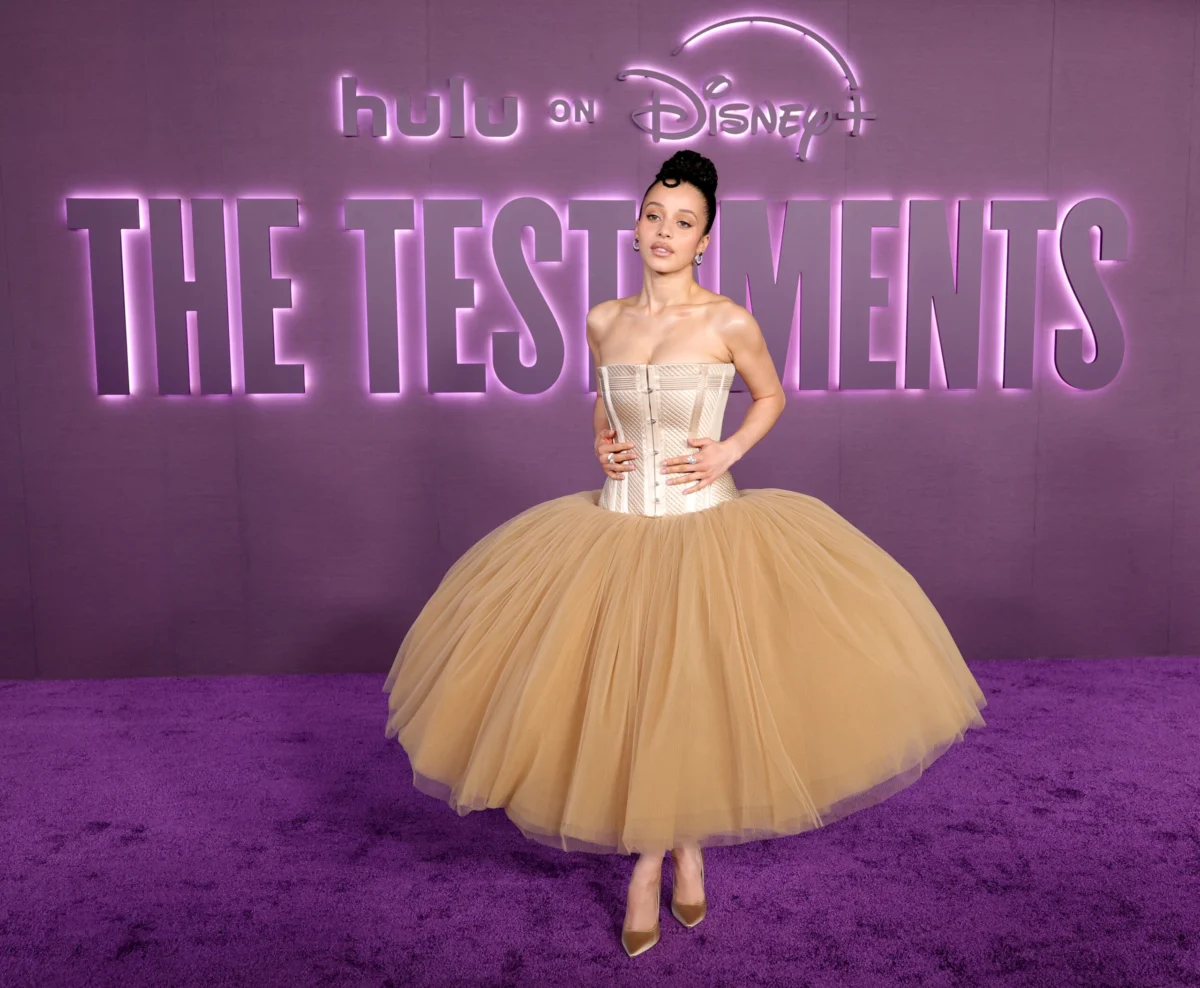
The Academy Museum of Motion Pictures was bathed in an atmospheric glow of purple hues on Tuesday evening as the stars and creators of Hulu’s highly anticipated series, The Testaments, gathered for its world premiere. The event marked a significant moment for the streaming giant, expanding its acclaimed dystopian universe established by The Handmaid’s Tale into a new narrative exploring the future of Gilead. Chase Infiniti, Ann Dowd, and Lucy Halliday, key members of the new ensemble cast, graced the purple carpet, offering insights into their roles and the thematic resonance of the series.
A New Era Dawns in Gilead
The Testaments, based on Margaret Atwood’s 2019 novel of the same name, is set approximately four years after the gripping conclusion of The Handmaid’s Tale. The series pivots to focus on the experiences of younger generations within the oppressive regime of Gilead, specifically following Agnes, portrayed by Chase Infiniti, and Daisy, played by Lucy Halliday, as they navigate the complexities of coming of age in a society that rigidly controls every aspect of life. The narrative promises to delve into themes of resistance, indoctrination, and the enduring human spirit against overwhelming odds.
For Chase Infiniti, this role represents a significant leap forward in her burgeoning career. Her star-making performance in One Battle After Another seemingly provided a crucial foundation for her work in The Testaments. "The thing that One Battle really prepared me for was, honestly, getting to work with an incredible group of girls," Infiniti shared with The Hollywood Reporter. "I feel very fortunate that One Battle taught me how to work in an ensemble and form connections with other actors. And I hope that the connection we built on this show can transcend the screen as well." This emphasis on ensemble chemistry is particularly relevant for a story that will likely explore the formation of alliances and the ripple effects of individual actions within a totalitarian system.
Bridging Generations and Narratives
Bruce Miller, the creative force behind The Handmaid’s Tale, returns as showrunner for The Testaments, tasked with translating Atwood’s complex literary work into a compelling visual narrative. The series is set to premiere with its initial three episodes on April 8th, a date circled by fans eager to revisit this meticulously crafted, albeit terrifying, world. Miller’s casting choices have been a focal point of discussion, particularly his selection of Infiniti for a lead role. He revealed a striking parallel between Infiniti and Elisabeth Moss, the acclaimed star of The Handmaid’s Tale.
"She was unpredictable," Miller explained, referring to Infiniti. "I didn’t know what she was going to do – not in a scary way, but I just didn’t have any idea what she was going to say, if she was going to go left or right. And as a person, she’s that way too. She’s delightful, but you don’t know if she’s going to say if she wants chocolate or vanilla ice cream, and no matter how much I get to know her, I don’t think I’m going to know, which is wonderful. It was the same thing with Elisabeth Moss; she’s not volatile, but she is unpredictable." This comparison suggests that Infiniti embodies a similar raw, captivating energy that made Moss’s portrayal of June Osborne so compelling. The continuity of this unpredictable yet grounded performance style is a key element in seamlessly transitioning between the two series.
A Spectacle of Gilead’s Oppression and Hope
The premiere event itself was designed to immerse attendees in the world of Gilead. Hulu orchestrated a striking visual display as two dozen young women, clad in the somber purple uniforms of Gilead’s wife-training institutions, processed in a solemn procession down the carpet. Each carried a small pie, a symbolic gesture that hinted at the domestic roles and expectations within the regime, before boarding a bus with curtained windows, evoking a sense of controlled departure or hidden journeys. This theatrical element served as a powerful prelude, setting a disquieting yet captivating tone for the evening.
The narrative of The Testaments is deeply intertwined with the evolving dynamics between Agnes and Daisy. Lucy Halliday elaborated on the synergy between herself and Infiniti, highlighting how their off-screen rapport directly translated into their on-screen performances. "Working with Chase was fantastic, and that friendship wasn’t hard to manifest," Halliday stated. "The second I met Chase, we had such an immediate connection. I landed the same day she landed in Toronto and we straightaway went to get dinner and I think having that relationship off screen really allowed for the frictious dynamic you see on-screen. We could really push each other and we weren’t afraid that we were going to offend this person or they were going to hate us at the end of it because we knew that we had that real friendship to fall back on." This mutual trust and established bond between the two lead actresses are crucial for portraying the nuanced and often challenging relationship between Agnes and Daisy within the confines of Gilead’s oppressive social structure.
Ann Dowd’s Resurgence as Aunt Lydia
A pivotal figure returning from the original series is Ann Dowd, reprising her Emmy-winning role as Aunt Lydia. In The Testaments, Aunt Lydia’s position has evolved significantly. She is now the formidable leader of the very school where Agnes and Daisy are students, continuing her role as an enforcer of Gilead’s brutal doctrines. However, Dowd hinted at a profound shift in her character’s internal landscape.
"It felt wonderful to come back. It’s a different Gilead," Dowd emphasized. "Lydia had time between The Handmaid’s Tale and the beginning of The Testaments to really change and accept that she had to change who she is, so we see a different side of Lydia – a different, softer and gentler person dealing with younger girls, still the girls that she loves who have always defined her life." This evolution suggests that while Lydia remains an instrument of the regime, her motivations and methods may have undergone a subtle, perhaps even reluctant, transformation, adding layers of complexity to her character. When questioned about any advice she imparted to the new Aunts portrayed by Mabel Lee, Ava Foote, and Zarrin Darnell Martin, Dowd playfully quipped, "Always follow the rules!" This response, delivered with her characteristic gravitas, underscores the enduring paradox of Lydia’s role: maintaining order through adherence to a system she may be internally questioning.
Thematic Underpinnings and Societal Reflections
The Testaments arrives at a time when discussions around reproductive rights, authoritarianism, and the erosion of personal freedoms remain critically relevant globally. The series, much like its predecessor, serves as a potent allegorical narrative, prompting viewers to consider the fragility of democratic societies and the consequences of unchecked power. The narrative’s focus on younger characters coming of age within such a restrictive environment offers a fresh perspective on how ideologies are perpetuated and how seeds of rebellion can be sown even in the most controlled settings.
The decision to create a follow-up series to The Handmaid’s Tale was a strategic one for Hulu, building upon the immense cultural impact and critical acclaim of the original. The Handmaid’s Tale garnered numerous awards, including multiple Primetime Emmy Awards and Golden Globe Awards, and its stark imagery and powerful themes resonated deeply with audiences worldwide, sparking widespread conversations and even influencing social and political activism. The Testaments aims to capture this same potent blend of social commentary and compelling drama, leveraging the established lore of Atwood’s universe to explore new facets of resistance and the enduring struggle for agency.
Production and Creative Continuity
The production team behind The Testaments draws heavily from the established talent pool of The Handmaid’s Tale, ensuring a consistent aesthetic and thematic coherence. The visual language, the meticulous set design, and the haunting score that defined the original series are expected to be carried forward, creating an immersive and unsettling experience for viewers. The series’ expansion into the lives of younger characters like Agnes and Daisy also allows for a narrative exploration of generational trauma and the potential for change passed down through families and communities. This approach can offer a more nuanced understanding of how individuals are shaped by their environment and the choices they make in the face of systemic oppression.
The critical reception of The Handmaid’s Tale has set a high bar for The Testaments. The original series was lauded for its unflinching portrayal of a totalitarian regime and its exploration of female subjugation, earning widespread critical acclaim and a dedicated global fanbase. The success of the source material, Margaret Atwood’s Pulitzer Prize-winning novel, further cemented its place in literary and cultural history. The adaptation’s ability to translate the novel’s visceral impact and complex themes to the screen has been a significant achievement. The Testaments faces the challenge of not only living up to these expectations but also forging its own identity within the established universe. The success of the new series will hinge on its ability to deliver a fresh narrative that builds upon the foundation of its predecessor while offering new insights into the enduring fight for freedom and autonomy.
The premiere event underscored the significant investment Hulu is making in expanding its portfolio of prestige dramas. By delving deeper into Margaret Atwood’s richly imagined world, the platform aims to capitalize on the existing audience’s engagement while attracting new viewers with a story that promises both familiarity and groundbreaking new perspectives. The intricate tapestry of Gilead, woven with threads of oppression, resilience, and the unyielding pursuit of hope, continues to captivate and provoke, making The Testaments a highly anticipated addition to the television landscape. The careful layering of new characters and plotlines, coupled with the return of beloved figures like Aunt Lydia, suggests a strategic approach to narrative evolution, promising to keep audiences on the edge of their seats as they witness the unfolding of this new chapter in the fight for Gilead’s soul.