Johny Marice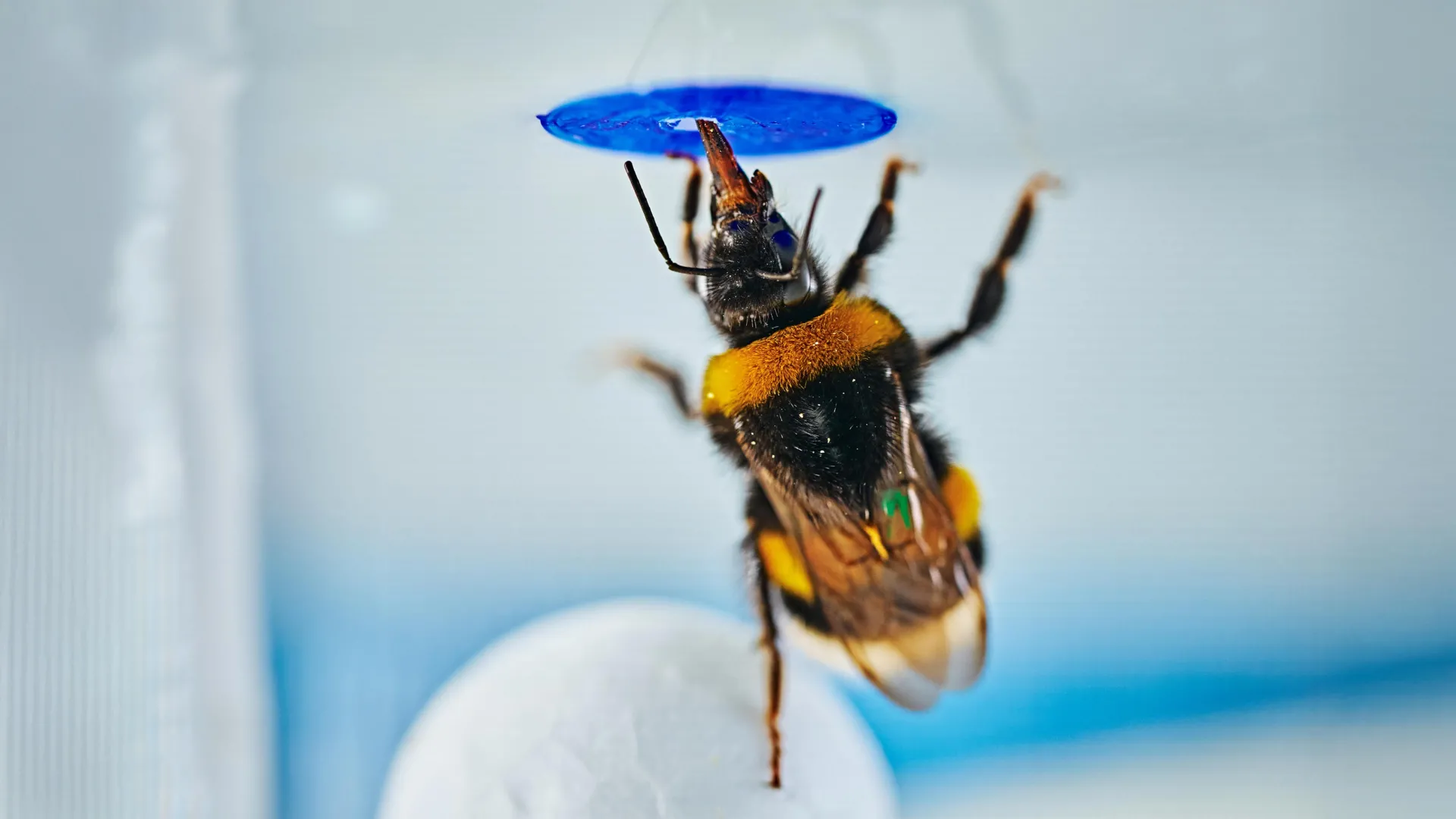
In a groundbreaking discovery that is poised to reshape our understanding of animal intelligence, scientists have observed bumble bees exhibiting a remarkable capacity for spontaneous problem-solving. This sophisticated cognitive ability, once thought to be the exclusive domain of humans and other vertebrates with significantly larger brains, was demonstrated when the insects successfully navigated a completely novel object manipulation task without any prior training or instruction. The findings, published in the prestigious journal Science, directly challenge a century-old paradigm in comparative psychology, suggesting that advanced problem-solving skills may not be as strictly linked to brain size as previously believed.
The research, conducted by a collaborative team from the University of Oulu, the University of Helsinki, and the University of Turku in Finland, harks back to seminal experiments conducted over a hundred years ago. In the early 20th century, psychologist Wolfgang Köhler’s observations of chimpanzees provided some of the earliest and most compelling evidence of "insight learning" in non-human animals. Köhler documented how chimpanzees, faced with challenges like reaching a suspended banana, would spontaneously devise solutions by creatively combining objects in their environment, such as stacking boxes. These demonstrations were pivotal in establishing that animals could achieve goals through sudden, novel understanding rather than purely through trial-and-error or learned associations. For decades, this capacity for spontaneous, object-based problem-solving was largely confined to the realm of primates and other large-brained vertebrates, leading to a widespread assumption that such complex cognitive feats were beyond the capabilities of insects with their comparatively minute nervous systems.
The Novel Challenge: A Tiny Brain’s Ingenuity
The Finnish research team devised an experimental setup that mirrored the essence of Köhler’s classic "box-and-banana" problem, but adapted for the bumble bee. The study focused on the buff-tailed bumble bee (Bombus terrestris), a species known for its complex social behaviors and foraging strategies. Initially, the bees were trained to associate a blue artificial flower with a sugar-water reward. This established a clear goal for the insects.
The critical phase of the experiment involved relocating this blue flower to the ceiling of a transparent arena, placing it tantalizingly out of reach. Crucially, a small, movable ball was also present within the arena. The bees were not trained in any way to interact with the ball in relation to the flower or the reward. Their prior learning extended only to recognizing the blue flower as a source of food and understanding that the ball was an object that could be moved.
Faced with this unprecedented situation – the reward suspended overhead and inaccessible – the bumble bees were presented with a problem that demanded a solution beyond their learned behaviors. The researchers observed that a significant proportion of the bees spontaneously devised a method to reach the reward. Their solution involved a sequence of actions that had never been taught: they would approach the ball, push or roll it directly beneath the suspended flower, and then climb onto the ball. From this elevated platform, they could then access the sugary reward.
"This is essentially an insect version of the classic ‘box-and-banana’ problem," explained senior author Olli Loukola, Docent at the University of Oulu. "The animal must realize that an object can be repositioned and then used as a tool to reach an otherwise inaccessible goal. What stands out about the result is that this kind of spontaneous problem-solving is now demonstrated in an insect."
The goal-directed nature of this behavior was particularly striking. "What makes this behavior especially remarkable is that the bees had never been trained to roll the ball," stated lead author Akshaye Bhambore from the University of Oulu. "This was a completely new challenge. Their behavior appeared goal-directed with successful individuals showing more directed movement patterns." This suggests that the bees were not merely exhibiting random actions but were actively strategizing to overcome the obstacle.
Rigorous Controls: Eliminating Alternative Explanations
A cornerstone of robust scientific inquiry is the rigorous elimination of alternative explanations. The research team implemented a series of sophisticated control experiments designed to rule out simpler interpretations of the bees’ behavior, such as accidental success, innate responses, play behavior, or reliance on direct visual cues.
One of the most critical controls involved ensuring that the bees were not simply reacting to the visual presence of the flower. In some trials, the flower was temporarily obscured from view as the bees moved the ball. Despite this visual limitation, many bees still managed to position the ball correctly beneath where the flower would be, indicating that their actions were not solely driven by direct visual guidance toward the target.
"Another important aspect is that our bees were fully naive," Loukola emphasized. "In many previous studies of insight-like problem-solving, the animals have had extensive experience with objects, test environments, or other problem-solving tasks. Here, the bees had never been trained to use the ball to reach the flower, and they had no previous experience with this kind of solution. We also designed the experiments to rule out simpler explanations such as accidental success, play behavior, trial-and-error learning, or direct visual guidance."
Furthermore, the researchers meticulously analyzed the bees’ movement patterns. By examining the trajectories and sequences of actions, they could differentiate between deliberate, goal-oriented behavior and random exploration or simple associative learning. "By analyzing the bees’ behavior across unusually stringent control experiments, we could show that they were not simply reacting to visual stimuli or moving the ball randomly," Bhambore confirmed. This detailed analysis provided strong evidence that the bees were engaging in genuine problem-solving.
A Century of Research Re-evaluated
The implications of this study are profound, potentially rewriting textbooks on animal cognition. For over a century, the focus on intelligence research has been heavily weighted towards vertebrates, particularly primates and mammals, due to their larger and more complex brains. Wolfgang Köhler’s work in the 1910s and 1920s, which first illuminated the capacity for spontaneous problem-solving, was conducted with chimpanzees and is considered a foundational text in this field. His experiments, which involved tasks like using tools to retrieve food or stacking objects to reach elevated items, demonstrated a level of cognitive flexibility that was thought to require significant neural processing power.
The prevailing scientific consensus stemming from Köhler’s work was that such "aha!" moments, where a solution appears suddenly and without prior direct instruction, were a hallmark of advanced intelligence, closely tied to the development of larger cerebral cortices. This perspective contributed to a hierarchical view of cognition, where complex problem-solving abilities were seen as a luxury afforded by a substantial brain size.
However, the findings with bumble bees introduce a significant counterpoint. While their brains are minuscule – estimated to contain around one million neurons, compared to the billions found in the human brain – they have demonstrated a capacity that was previously attributed to much more neurologically complex creatures. This discovery suggests that the underlying neural mechanisms for flexible, goal-directed problem-solving might be more fundamental and potentially more widespread across the animal kingdom than previously assumed.
Tiny Brains, Big Implications: The Expanding Frontier of Insect Cognition
The study’s findings add to a growing body of evidence suggesting that insects, and bees in particular, possess a far more sophisticated cognitive repertoire than their small size might imply. Previous research has already revealed impressive abilities in bees, including:
- Social Learning of Tool Use: Bees have been shown to learn how to use tools by observing other bees.
- Complex Puzzle Solving: They can navigate intricate puzzle boxes to access rewards.
- Cooperative Behavior: Evidence suggests they can cooperate with each other to achieve common goals.
- Behavioral Adaptation: Bees demonstrate an ability to adapt their foraging strategies to changing environmental conditions.
The current research, however, elevates this understanding by demonstrating spontaneous problem-solving. This is distinct from learning through observation or trial-and-error, as it involves an emergent solution to a novel situation. The researchers are quick to clarify that these findings do not equate insect cognition to human consciousness or thought processes. "We are not claiming that bees think like humans," stated Loukola, who is now a Senior Researcher at the University of Turku. "But our findings show that miniature brains can generate flexible solutions to novel problems in ways we are only beginning to understand."
This distinction is crucial. The researchers are focused on the observable behavior and the cognitive flexibility it represents, rather than speculating on subjective experience. The study suggests that the capacity for generating novel solutions to unforeseen challenges may be a more ancient and evolutionarily conserved trait than previously appreciated, and that it can arise from neural architectures far simpler than those found in vertebrates.
Future Directions and Broader Impact
The implications of this research extend beyond the fascinating world of insect behavior. It prompts a re-evaluation of how intelligence is defined and measured across different species. If spontaneous problem-solving can emerge in such small brains, it suggests that future research should explore these capacities in a wider range of invertebrate species.
The study’s authors, Akshaye A. Bhambore, Ece N. Akmeşe, Emma Häkkinen, Milla K. Jussila, Juha-Heikki Kantola, and Olli J. Loukola, published their findings in the June 4, 2026, issue of Science under the title "Spontaneous problem-solving in bumble bees." This landmark publication is expected to stimulate further research into the neural basis of flexible cognition in small-brained animals and may lead to new insights into the evolutionary origins of problem-solving abilities.
The research team’s meticulous experimental design and rigorous controls have provided compelling evidence that challenges established scientific dogma. The image of the humble bumble bee, once primarily associated with pollination, is now enhanced with the recognition of its remarkable cognitive capabilities. This discovery not only expands our appreciation for the diversity of intelligence on Earth but also opens new avenues for understanding the fundamental principles of problem-solving, regardless of the size of the brain that orchestrates it. The conversation about animal intelligence, it seems, has just gained a very small, yet exceptionally significant, new participant.