Jono Maryono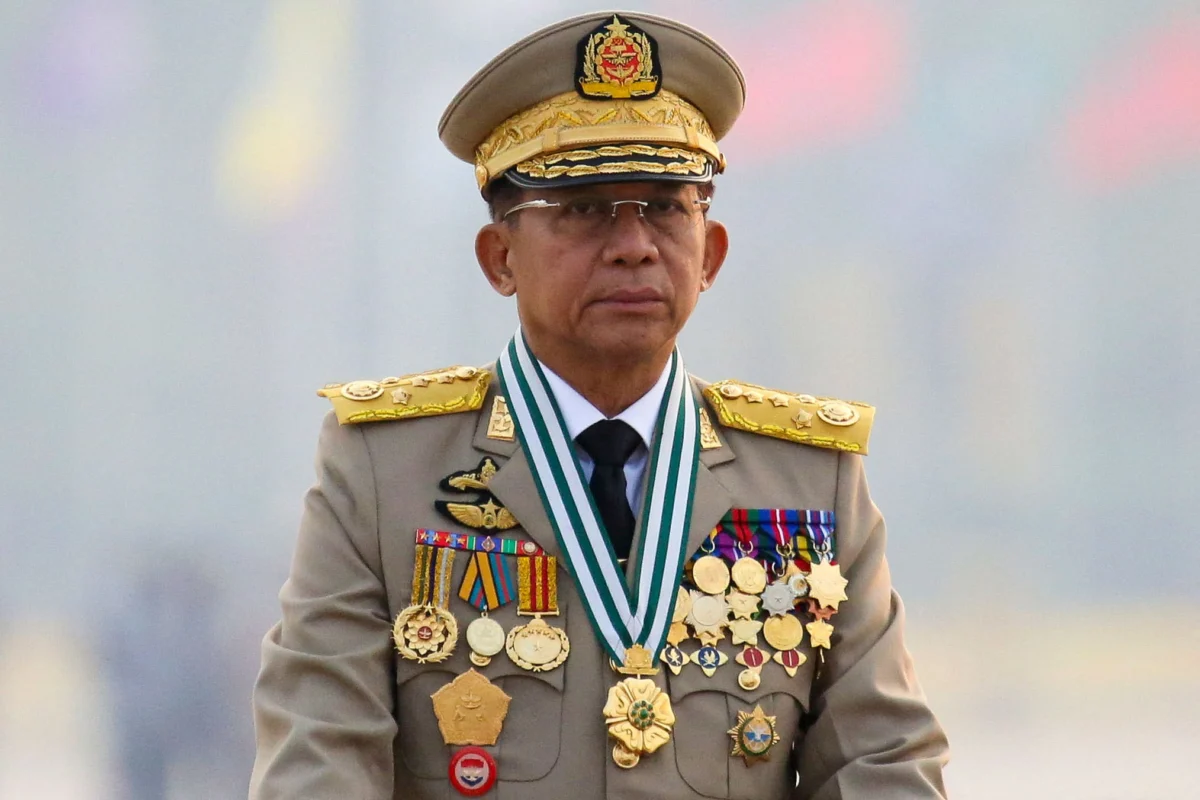
Myanmar’s junta leader, Min Aung Hlaing, has officially secured the presidency following a parliamentary vote, consolidating his grip on power five years after orchestrating a coup that ousted the democratically elected government of Aung San Suu Kyi. The 69-year-old general garnered at least 293 votes out of 584 cast by members of the pro-military parliament on Friday, surpassing the necessary majority threshold. This transition marks a significant, albeit contentious, step in the nation’s turbulent political landscape, which has been plagued by widespread protests and a burgeoning civil war since the February 2021 takeover.
The parliamentary vote, widely anticipated, saw Min Aung Hlaing comfortably achieve the required votes. He was one of three candidates nominated for the presidency earlier in the week. This move follows a controversial general election held in December and January, which saw a landslide victory for an army-backed political party. Critics and Western governments have widely condemned the election as a pre-determined exercise designed to legitimize military rule under a façade of democracy. The Union Solidarity and Development Party (USDP), the primary political vehicle of the military, secured over 80 percent of the contested parliamentary seats. Furthermore, a quarter of all parliamentary seats are reserved for unelected members of the armed forces, ensuring their continued influence regardless of election outcomes.
Min Aung Hlaing’s ascension to the presidency is a position analysts suggest he has long coveted. His ascent to this civilian role comes shortly after a significant leadership reshuffle within Myanmar’s powerful military, which he has commanded since 2011. On Monday, concurrently with his nomination for the presidency, Min Aung Hlaing appointed Ye Win Oo, a former intelligence chief known for his staunch loyalty to the general, as his successor to lead the Tatmadaw, Myanmar’s armed forces. This strategic military handover is viewed by observers as a calculated maneuver to solidify his authority. By transitioning to the head of a nominally civilian government, Min Aung Hlaing aims to enhance his international legitimacy while safeguarding the enduring interests of an armed forces that has directly governed the country for the majority of the past six decades.
A Nation Divided: The Genesis of the Coup and Resistance
The current political predicament in Myanmar is rooted in the military’s seizure of power on February 1, 2021. The Tatmadaw, under Min Aung Hlaing’s command, alleged widespread fraud in the November 2020 general election, which saw a resounding victory for Aung San Suu Kyi’s National League for Democracy (NLD). Despite the absence of credible evidence to support these claims, the military detained State Counsellor Aung San Suu Kyi, President Win Myint, and numerous other political figures, effectively dismantling the nascent democratic transition that had begun in 2011.
The coup triggered immediate and widespread protests across the country, characterized by civil disobedience campaigns, strikes, and mass demonstrations. These peaceful protests were met with brutal force by the security forces, leading to a significant loss of life and further fueling public anger. In response to the escalating violence and the military’s suppression of dissent, various groups began to organize and arm themselves, leading to the formation of the People’s Defence Forces (PDFs). These armed resistance groups, often operating in conjunction with established ethnic armed organizations (EAOs) that have long fought for autonomy, have engaged in a protracted civil war against the junta.
Timeline of Key Events
- November 8, 2020: Myanmar holds a general election. The National League for Democracy (NLD) wins a landslide victory, securing 396 out of 476 seats.
- February 1, 2021: The Myanmar military (Tatmadaw) stages a coup, detaining State Counsellor Aung San Suu Kyi and other elected officials, alleging electoral fraud.
- February 2021 onwards: Widespread protests erupt across Myanmar, met with violent suppression by the military.
- March 2021: The People’s Defence Forces (PDFs) begin to emerge as armed resistance groups.
- May 2021: The National Unity Government (NUG), formed by ousted lawmakers and activists, declares itself the legitimate government of Myanmar.
- 2021-2023: Intensified conflict between the military and resistance forces, particularly in urban areas and ethnic minority regions.
- December 2023 – January 2024: The military junta holds a general election, boycotted by the NUG and many opposition groups, and deemed illegitimate by international observers. The army-backed USDP wins a substantial majority.
- February 2024: Min Aung Hlaing is nominated for the presidency.
- March 2024: Min Aung Hlaing is officially elected president by the pro-military parliament.
Supporting Data: The Economic and Human Toll
The ongoing conflict has exacted a devastating toll on Myanmar’s population and economy. According to the United Nations, over 1.5 million people have been displaced internally since the coup. The World Bank estimates that Myanmar’s economy contracted by 18% in 2021 and has struggled to recover since. Foreign investment has plummeted, and critical sectors like tourism and manufacturing have been severely impacted.
Access to essential services, including healthcare and education, has been disrupted in many conflict-affected areas. Reports from human rights organizations indicate widespread allegations of war crimes and crimes against humanity committed by the military, including arbitrary detentions, torture, extrajudicial killings, and the targeting of civilians and civilian infrastructure. The World Food Programme has warned of rising food insecurity, with millions of people facing acute hunger.
Official Responses and International Reactions
The Myanmar military junta has consistently defended its actions as necessary to restore order and stability. It has dismissed international criticism as interference in its internal affairs. State-controlled media outlets have portrayed the ongoing conflict as a fight against "terrorists" and "insurgents" who are undermining national sovereignty.
Internationally, the coup and the subsequent military rule have been widely condemned. The United States, the European Union, the United Kingdom, and Australia have imposed targeted sanctions on military leaders and entities associated with the junta. These sanctions aim to limit the military’s access to funding and resources. However, neighboring countries, particularly China and Thailand, have maintained more pragmatic relations with the junta, driven by strategic and economic interests. ASEAN (Association of Southeast Asian Nations) has struggled to forge a unified response, with internal divisions hindering effective diplomatic pressure.
The United Nations General Assembly has repeatedly called for the release of all political prisoners, the cessation of violence, and the restoration of democracy. However, the Security Council has been hampered by vetoes from China and Russia, preventing stronger unified action.
Broader Impact and Implications: A Fractured Future
Min Aung Hlaing’s formal assumption of the presidency signals a determined effort by the military to entrench its power and present a semblance of legitimate governance. However, this move occurs against a backdrop of escalating civil war and widespread popular rejection. The election, which served as a precursor to this presidential appointment, was widely criticized for its lack of credibility, with reports of voter intimidation and the exclusion of opposition voices. The USDP’s overwhelming victory, coupled with the reserved seats for the military, ensures that the parliament remains firmly under the junta’s control.
The strategic decision to appoint a loyalist as military chief while assuming the presidency suggests a desire to separate the military’s command structure from the political leadership, a common tactic employed by authoritarian regimes to consolidate power and create a more palatable international image. This move could be aimed at projecting an image of civilian oversight, even as the military retains ultimate authority.
However, the underlying conditions that fueled the resistance remain unchanged. The formation of a new combined front by various anti-military groups, including elements of Aung San Suu Kyi’s party and long-standing ethnic minority armies, highlights the persistent and evolving nature of the opposition. The stated objective of this coalition – "to completely dismantle all forms of dictatorship, including the military dictatorship, and to collectively initiate a new political landscape" – underscores the deep-seated desire for fundamental change.
The implications of this political consolidation are multifaceted. For the resistance, it may mean facing intensified military pressure and potentially increased scrutiny from neighboring countries, some of which might seek to foster closer ties with Min Aung Hlaing’s new administration to ensure regional stability and protect their own interests. For the international community, it presents a continued challenge in engaging with a regime that lacks democratic legitimacy and perpetuates widespread human rights abuses. The path forward for Myanmar remains deeply uncertain, with the prospect of a prolonged and devastating conflict appearing increasingly likely as the military junta seeks to solidify its hold on power while facing a determined and increasingly unified opposition. The vision of a Federal Democratic Union, as articulated by emerging resistance councils, stands in stark contrast to the military’s ambition for a centrally controlled state, setting the stage for a protracted struggle for the future of Myanmar.