Jono Maryono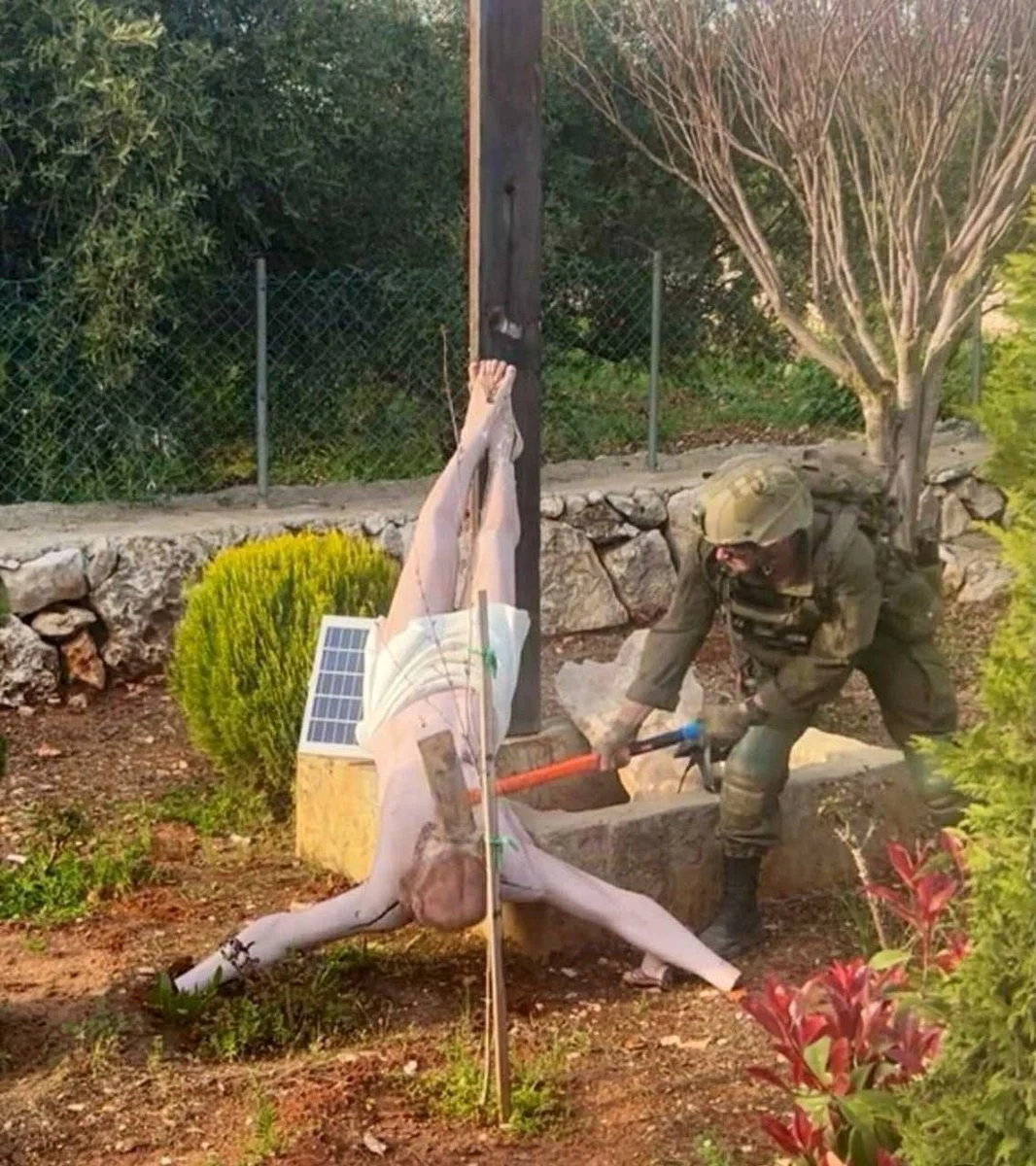
Footage of an Israeli soldier using a sledgehammer to deface a Christian statue depicting the crucifixion of Jesus Christ in southern Lebanon has presented a significant challenge to Israel’s political establishment, which has long cultivated an image as a protector of Christian communities and a close ally of the powerful Christian Zionist movement in the United States. The incident, which surfaced and rapidly went viral on social media, occurred against a backdrop of increasing international criticism of Israel’s military operations in Gaza and escalating tensions with Lebanon and Iran. This erosion of support in the West, even among Christian constituencies, predates the widely shared video, but the desecration of a sacred Christian symbol has amplified these concerns and complicated Israel’s diplomatic efforts.
Prime Minister Benjamin Netanyahu responded to the viral video on Monday, a day after its initial spread, reiterating his government’s commitment to respecting all religions. This assertion, however, has been met with skepticism by critics who point to a pattern of actions by his government that they argue contradict this stated policy. The incident has forced a more visible and decisive response from the Israeli government than might otherwise have been expected, particularly given the significant role Christian supporters play in bolstering Israel’s international standing, especially within the United States.
In a swift reaction aimed at mitigating the diplomatic fallout, Israel announced on Tuesday that the soldier filmed destroying the statue had been jailed for 30 days, with another soldier who recorded the act also facing detention. Six other soldiers have reportedly been summoned for questioning. This decisive action stands in stark contrast to the outcomes of many previous Israeli military investigations into alleged violations by soldiers, which have historically resulted in a low rate of charges or convictions, even in cases involving significant loss of Palestinian life. For instance, no Israeli soldier has been charged with killing a Palestinian in the past decade, despite thousands of Palestinian deaths occurring outside the context of the current Gaza war, including the high-profile 2022 killing of Al Jazeera correspondent Shireen Abu Akleh, who was herself Christian.
Yossi Mekelberg, a senior consulting fellow at Chatham House, emphasized the strategic importance of Israel’s visible response to the attack on the statue. He noted that such a public demonstration of accountability is crucial for maintaining the support of Christian allies, a demographic that has been instrumental in shaping U.S. policy towards Israel, particularly during the Trump administration, which saw figures like U.S. Ambassador to Israel David Friedman, a prominent figure in Orthodox Jewish circles, and many evangelical leaders actively championing Israeli interests. These supporters often frame their backing for Israel through the lens of Christian Zionist interpretations of biblical prophecy and a shared "Judeo-Christian" value system.
However, the decisive action taken in this specific case inadvertently highlights the perceived inaction or inadequate response in other instances of alleged Israeli misconduct. Mekelberg commented, "This [attack on the statue of Jesus], and the attacks upon mosques by settlers and the killing of Palestinians are all war crimes. The problem is that we don’t know how widespread it is. We only know about this one because they filmed it." This sentiment underscores a growing concern that the visibility of incidents, rather than their severity or frequency, often dictates the level of official Israeli response and subsequent international outcry.
A Pattern of Tensions and Contradictions
The incident in Lebanon is not an isolated event that can be easily dismissed. Observers and analysts have repeatedly noted a discernible difference in the Israeli government’s handling of incidents involving Christian sites compared to the widespread destruction of Islamic infrastructure, particularly during prolonged conflicts in Gaza and Lebanon.
In March, Prime Minister Netanyahu faced a similar public relations challenge when Israeli police blocked Cardinal Pierbattista Pizzaballa, the Latin Patriarch of Jerusalem, from entering the Church of the Holy Sepulchre on Palm Sunday. The incident, which occurred on one of the holiest days in the Christian calendar, necessitated a rapid public statement from Netanyahu, who claimed "no malicious intent whatsoever, only concern for his safety," to quell the ensuing controversy.
Furthermore, in July of the previous year, Netanyahu issued an apology for an Israeli airstrike on a Catholic church in Gaza that was sheltering civilians. The strike resulted in the deaths of three individuals and injured several others, including the parish priest. This apology, issued under pressure from the Trump administration, came after hundreds of people were taking refuge in the church. Netanyahu expressed his deep regret, calling the strike an "accident" and stating, "Every innocent life lost is a tragedy. We share the grief of the families and the faithful." This statement, however, did not acknowledge the broader context of nearly 60,000 Palestinian men, women, and children who had been killed by Israeli forces up to that point in the war.
Throughout the ongoing conflict, proponents of Israel’s actions have frequently invoked the concept of "Judeo-Christian values" to legitimize its military campaigns and its repeated breaches of international law. However, the repeated attacks on Christian symbols and the challenges faced by Christian communities within Israel and the Palestinian territories cast doubt on the sincerity of this professed shared civilizational bond. Palestinian Christians, like their Muslim neighbors, experience the same challenges of dispossession and occupation.
H.A. Hellyer, a senior fellow at the Center for American Progress and a senior associate fellow at the Royal United Service Institute, articulated this disconnect: "I think a lot of Israel’s defenders in the West like to portray it as being ‘us,’ just over there, as if ‘over there’ is some form of dark jungle. So, they can make excuses for Israelis killing Arabs in their thousands. They can even make excuses for them killing Christians. But when you see Israeli soldiers destroying Christian symbols, it becomes much harder to defend those actions and to stem the growing trend of US supporters, both Democrat and Republican, moving away from Israel."
Escalating Tensions Within Israel and Occupied Territories
Beyond the international stage, the treatment of Christians within Israel and the occupied territories has also become a growing concern. While the Israeli government actively seeks to portray an image of interfaith harmony and emphasizes the "Judeo-Christian" connection, reports of harassment and discrimination against Christian communities are on the rise, particularly with the ascendancy of the far-right within Israeli politics and government.
Data compiled by the interreligious Rossing Center for Education and Dialogue paints a concerning picture. In 2025, the center recorded 155 incidents targeting Christians in Israel, representing a significant increase from the preceding year. While physical assaults constituted the largest category, accounting for 39 percent of reported incidents, the data also included instances of spitting, hitting, and pepper-spraying directed at members of the Christian community.
Christian holidays, particularly those around the Easter period, have emerged as focal points of heightened tension. The report noted that priests and nuns wearing distinctive Christian attire in West Jerusalem and occupied East Jerusalem face the risk of harassment when navigating public spaces.
The "Permanent Security" Doctrine and Cultural Denigration
Prominent Israeli sociologist Yehouda Shenhav-Shahrabani suggests that Israel may be entering a phase characterized by what Australian genocide studies scholar Dirk Moses terms "permanent security." In such a paradigm, anything perceived as different or potentially threatening, even in the future, is targeted for elimination. Shenhav-Shahrabani argues that this mindset extends to the very fabric of cultural and religious difference inherent to Christianity.
"It’s not about left or right," Shenhav-Shahrabani explained, pointing to deeper cultural currents. "It even goes to language. In everyday Hebrew, people refer to Jesus as Yeshu, which is a curse word, rather than Yeshua, which is correct. That’s commonplace. That’s how it’s used in everyday media. If that’s where you begin, it doesn’t matter if it’s stupidity or ignorance, it all leads to the same place." This linguistic denigration, he suggests, reflects a broader undercurrent of intolerance that can manifest in more overt acts of aggression.
Broader Implications for Israel’s International Standing
The video of the desecrated statue, amplified by social media, has had immediate and tangible diplomatic repercussions. It has provided ammunition to critics of Israel’s policies, both internationally and within the United States, potentially accelerating a shift in public opinion and political alignment. For a country that has long relied on its image as a bastion of Western values and a persecuted minority seeking refuge, the portrayal of its soldiers engaging in acts of religious vandalism poses a significant threat to its carefully constructed narrative.
The incident underscores the complex and often contradictory nature of Israel’s relationships with religious communities, both domestically and abroad. While political leaders may emphasize shared values and alliances, the actions of individuals on the ground, particularly when captured on video, can reveal deeper societal tensions and challenge long-held perceptions. The response to this particular incident, while swift, also raises critical questions about accountability and consistency in addressing alleged violations of human rights and international law. As the conflict in Gaza continues and regional tensions persist, the implications of this event for Israel’s international standing and its relationships with Christian communities worldwide are likely to be far-reaching and enduring. The ability of Israel to maintain its strategic alliances and international support may increasingly depend on its capacity to demonstrate genuine respect for all religious and cultural identities, not just when it is politically expedient, but as a fundamental principle of its governance and military conduct.