
 Johny Marice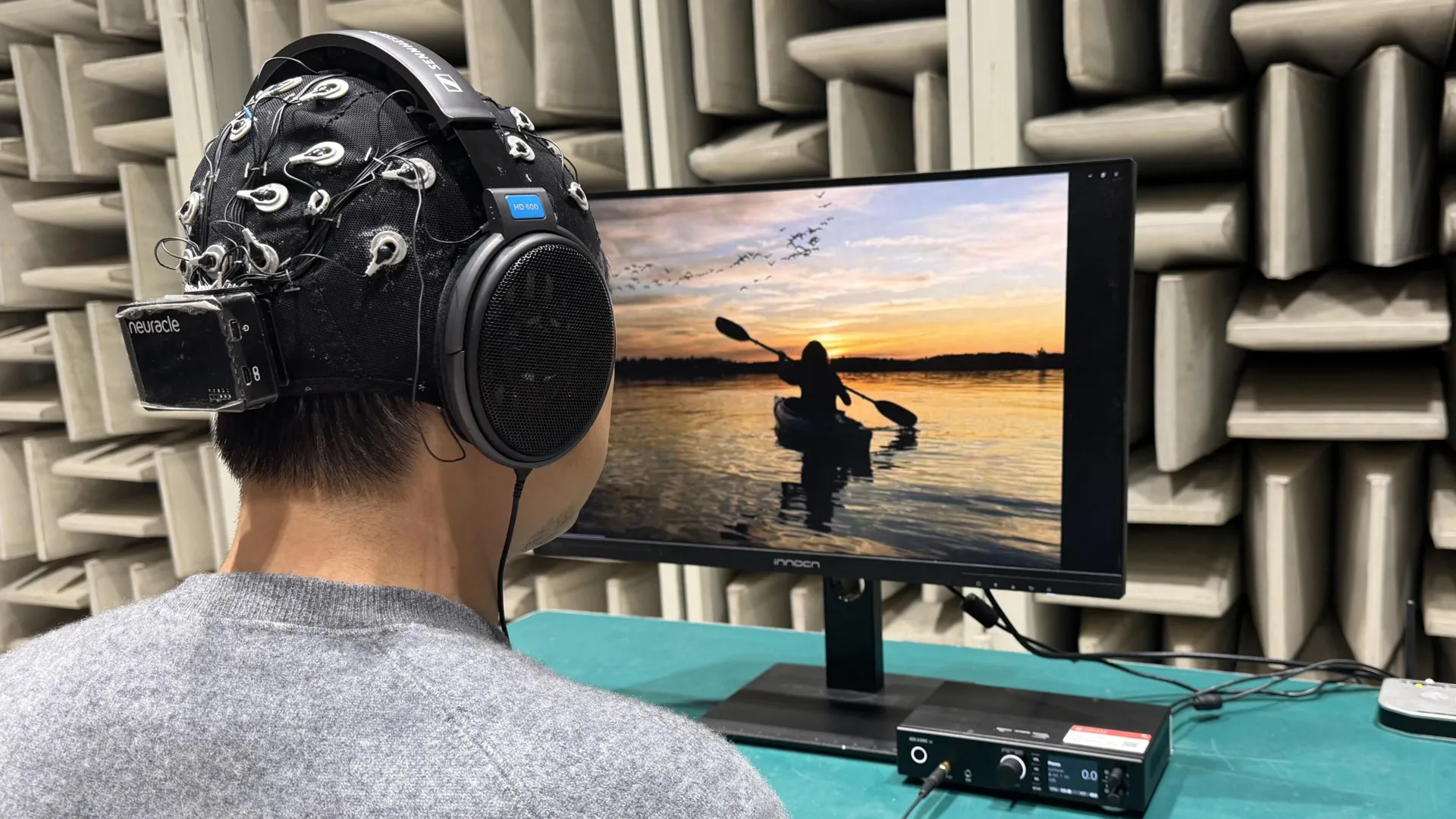
The intuitive act of closing one’s eyes when trying to discern a faint sound, a behavior deeply ingrained in human experience, has been widely presumed to enhance auditory focus by minimizing visual distractions. This deeply held belief suggests a straightforward reallocation of cognitive resources, channeling more processing power towards the auditory stream. However, a groundbreaking study published in The Journal of the Acoustical Society of America (JASA), by AIP Publishing, directly challenges this long-standing assumption, particularly in environments saturated with background noise. Researchers from Shanghai Jiao Tong University have meticulously investigated the intricate interplay between visual input and auditory perception, revealing a more complex reality than commonly understood.
Unraveling the Auditory-Visual Dichotomy: A Scientific Inquiry
The research project, initiated with the objective of rigorously testing the efficacy of eye closure in noisy listening conditions, employed a sophisticated experimental design. Participants were tasked with identifying sounds amidst varying levels of ambient noise, a scenario mirroring many real-world listening challenges. The core of the experiment revolved around the participants’ ability to detect sounds when presented under different visual conditions. This systematic approach aimed to quantify the precise impact of visual engagement on auditory sensitivity.
The Experimental Protocol: A Controlled Auditory Challenge
The study’s methodology involved a series of carefully controlled listening tasks. Participants were equipped with high-fidelity headphones, through which a spectrum of auditory stimuli was delivered. Simultaneously, a constant stream of background noise was introduced, creating a challenging auditory environment. The participants’ primary objective was to adjust the volume of the target sounds until they were just perceptibly audible above the masking noise. This "just audible" threshold served as the key metric for assessing auditory sensitivity.
The visual component of the experiment was designed to systematically vary the level of visual input:
- Eyes Closed Condition: Participants performed the auditory detection task with their eyes completely shut. This condition served as the baseline for the popular belief, aiming to isolate the auditory system.
- Eyes Open, Blank Screen Condition: Participants kept their eyes open but focused on a uniformly blank visual field. This condition aimed to control for the mere presence of visual input without any specific content.
- Eyes Open, Still Image Condition: Participants viewed a static image that was thematically related to the auditory stimulus they were trying to detect. This introduced a degree of congruent visual information.
- Eyes Open, Matching Video Condition: In the most visually engaging condition, participants watched a dynamic video that directly corresponded to the sound they were hearing. This represented a high level of multisensory integration.
The Surprising Findings: Vision as an Auditory Ally
The results of this meticulously designed experiment yielded findings that directly contradicted the widely held intuition. Contrary to the popular notion that closing one’s eyes enhances hearing, the study revealed the opposite. "We found that, contrary to popular belief, closing one’s eyes actually impairs the ability to detect these sounds," stated Yu Huang, a lead author on the study. "Conversely, seeing a dynamic video corresponding to the sound significantly improves hearing sensitivity."
This finding suggests that, particularly in noisy environments, the supposed benefit of removing visual distractions is not only absent but actively detrimental. Instead of fostering a more focused auditory experience, the absence of visual input appears to hinder the brain’s capacity to isolate and process faint sounds. The study unequivocally demonstrated that relevant visual cues provided a tangible advantage, enhancing the participants’ ability to perceive sounds that would have otherwise been masked by background noise.
The Neural Underpinnings: Brain Activity and the Paradox of Filtering
To delve deeper into the neurological mechanisms driving these surprising results, the researchers employed electroencephalography (EEG) to monitor brain activity throughout the experimental sessions. EEG allows for the real-time measurement of electrical activity in the brain, providing insights into cognitive processes.
The EEG data revealed a fascinating divergence in brain states depending on the visual condition. When participants closed their eyes, their brain activity shifted into a state characterized by heightened "neural criticality." This state, while beneficial for certain cognitive functions, is associated with an amplified filtering of incoming information.
Over-Filtering: The Downside of Internal Focus
This heightened filtering mechanism, triggered by eye closure, does not discriminate solely between target sounds and background noise. Instead, it exerts a more generalized suppression of sensory input. Consequently, the very sounds participants were attempting to detect were also being actively filtered out, albeit to a lesser degree than the ambient noise.
"In a noisy soundscape, the brain needs to actively separate the signal from the background," explained Huang. "We found that the internal focus promoted by eye closure actually works against you in this context, leading to over-filtering, whereas visual engagement helps anchor the auditory system to the external world."
This suggests that the brain, when deprived of visual input and encouraged to focus internally, becomes overly selective. It prioritizes internal processing at the expense of external sensory fidelity, leading to a diminished ability to detect subtle auditory cues in a complex environment. The visual system, by contrast, appears to play a crucial role in anchoring the auditory system to the external world, providing a stable reference point against which auditory signals can be better differentiated from noise.
Nuances and Exceptions: When Darkness Might Still Aid Hearing
While the study’s primary findings challenge the conventional wisdom in noisy environments, the researchers acknowledged that the effect is not universally applicable. They noted that in quieter conditions, closing the eyes might still offer an advantage. In the absence of significant background noise, the brain’s filtering mechanisms might be less critical, and the removal of even minor visual distractions could indeed allow for a more refined detection of subtle auditory nuances.
However, the practical implications of this distinction are significant. In the vast majority of everyday situations, from bustling city streets to crowded offices, background noise is an ever-present factor. Therefore, for most individuals navigating the complexities of modern life, keeping one’s eyes open and actively engaging with the visual environment may represent the more effective strategy for optimizing auditory perception.
Future Directions: Deconstructing Multisensory Integration
The Shanghai Jiao Tong University research team is committed to further exploring the intricate relationship between vision and hearing. A key area of ongoing investigation centers on discerning whether the observed benefits stem from the mere presence of visual input or specifically from the congruence between visual and auditory information.
"Specifically, we want to test incongruent pairings — for example, what happens if you hear a drum but see a bird?" Huang elaborated. "Does the visual boost come from simply having the eyes open and processing more visual information, or does the brain require the visual and audio information to match perfectly? Understanding this distinction will help us separate the general effects of attention from the specific benefits of multisensory integration."
This line of inquiry aims to disentangle the general attentional benefits of visual engagement from the more profound advantages conferred by true multisensory integration, where congruent information from different senses is processed in a unified manner. The findings from these future studies could have profound implications for our understanding of perception, the design of assistive listening devices, and even educational strategies aimed at enhancing learning through sensory engagement.
Broader Implications and Expert Commentary
The implications of this research extend beyond academic curiosity, touching upon practical applications in fields ranging from audiology to human-computer interaction. For individuals with hearing impairments, understanding how visual cues can augment auditory perception could lead to the development of more effective assistive technologies and rehabilitation strategies. For instance, visual aids that synchronize with auditory stimuli could significantly improve comprehension in noisy environments.
Dr. Eleanor Vance, a leading neuroscientist specializing in sensory processing (though not involved in this specific study), commented on the significance of the findings. "This study provides compelling empirical evidence for a phenomenon that many have intuitively felt but struggled to quantify. The concept of ‘over-filtering’ due to internal focus is a crucial insight. It highlights that our sensory systems are not simply passive recipients of information but actively engage in complex filtering and integration processes. The brain’s strategy for dealing with information overload is more dynamic and context-dependent than we often assume."
The study also has implications for how we design environments and technologies. For example, in the development of virtual reality experiences or augmented reality applications, careful consideration of the interplay between visual and auditory stimuli could significantly enhance user immersion and comprehension. The research suggests that simply presenting more visual information is not always the answer; it is the nature and relevance of that visual information that truly matters.
A Historical Perspective on Sensory Perception
The intuitive reliance on closing one’s eyes to hear better has roots that likely predate scientific inquiry. In prehistoric times, heightened auditory awareness might have been crucial for survival, alerting individuals to predators or prey. In such scenarios, minimizing distractions, including visual ones, could have been a critical evolutionary adaptation. This deeply ingrained behavioral response has been passed down through generations, becoming a common heuristic for improving auditory focus.
However, the modern auditory landscape is vastly different. The pervasive presence of artificial noise, from traffic to electronic devices, presents a novel challenge to our sensory systems. This research suggests that our evolutionary adaptations, while still valuable, may not be optimally suited for these contemporary listening environments. The brain’s adaptive capacity, as demonstrated by the study, is capable of recalibrating its strategies, and visual engagement appears to be a key component of this recalibration in noisy conditions.
The Role of Multisensory Integration in Cognitive Function
This research underscores the growing understanding of multisensory integration – the process by which the brain combines information from different sensory modalities to create a coherent perception of the world. This integration is not merely additive; it can lead to synergistic effects where the combined sensory input is perceived as more than the sum of its parts. The study’s findings suggest that visual information can act as a powerful modulator of auditory processing, enhancing its clarity and discriminability, especially when the visual and auditory signals are congruent.
The concept of "attentional blink" and its visual-auditory counterparts are also relevant here. When the brain is heavily engaged in processing one type of sensory information, it can become temporarily less efficient at processing subsequent information from the same or another modality. This research suggests that in noisy auditory environments, the brain’s attempt to compensate for the lack of visual input may inadvertently lead to a form of attentional deficit for the very sounds it is trying to perceive.
In conclusion, while the instinct to close one’s eyes when straining to hear may be deeply ingrained, scientific evidence now suggests that this practice can be counterproductive in noisy environments. The active engagement of the visual system, particularly with congruent visual stimuli, appears to be a more effective strategy for enhancing auditory perception and navigating the complex soundscapes of modern life. This research opens new avenues for understanding sensory perception and developing innovative applications that leverage the powerful synergy between sight and sound.








