
 Reynand Wu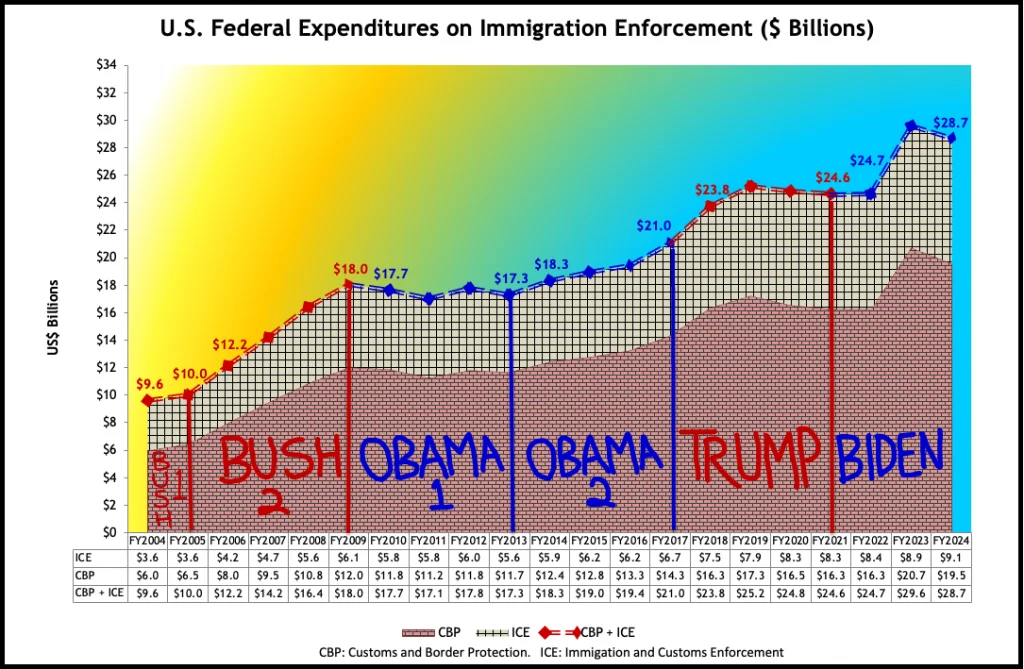
The construction and maintenance of state borders are far from organic phenomena; they are deliberate, costly undertakings shaped by political conflict, nationalist discourse, and economic disparities, often obscured by official narratives. A comprehensive analysis of federal spending reveals that the United States has dedicated an astonishing $409.4 billion of public funds to immigration enforcement and border security over the past 21 years, from fiscal year 2004 to fiscal year 2024. This colossal financial commitment underscores a deeply entrenched, bipartisan consensus on border securitization, despite significant rhetorical differences between Republican and Democratic administrations regarding immigration policy. This expenditure has not only fortified physical barriers but has also dramatically expanded the institutional machinery dedicated to apprehending, detaining, and deporting individuals perceived as ‘outsiders,’ fundamentally redefining the relationship between the state and its frontiers.
A Bipartisan Investment in Border Securitization
The arbitrary and often violent origins of state borders are frequently normalized through public policy and political rhetoric. Beyond their primary function of delineating national territory, borders serve crucial social roles, such as maintaining distinct political systems, differentiating between citizens and non-citizens, and constructing economic disparities through varying trade relations, national currencies, and value regimes. In the U.S. context, this abstract concept of a border translates into concrete infrastructure, advanced surveillance technology, and a vast human apparatus, all powered by substantial public investment.
The federal budget allocated to border policing has nearly tripled in unadjusted dollars, soaring from $9.6 billion in FY2004 to an estimated $28.7 billion in FY2024. When adjusted for inflation to 2024 dollars, this still represents a significant increase from approximately $17.5 billion to $28.7 billion. This exponential growth highlights a persistent and accelerating commitment to border enforcement, regardless of which political party occupies the White House. Of the total $409.4 billion spent, Republican presidents oversaw $178.9 billion, averaging $17.9 billion annually, while Democratic presidents were responsible for $230.5 billion, averaging a higher $21.0 billion annually. This data challenges the perception of stark partisan divides on immigration, revealing a practical convergence on policy implementation, particularly concerning funding.
The Post-9/11 Catalyst: A New Era of Border Enforcement
The events of September 11, 2001, served as a pivotal moment in the securitization of the U.S. border, particularly the US-Mexico frontier. Prior to 9/11, border enforcement, while present, operated on a significantly smaller scale. The U.S. Border Patrol, established in 1924, had seen gradual increases in personnel and resources over the decades, notably with initiatives like Operation Gatekeeper in California in the mid-1990s. However, the prevailing discourse shifted dramatically after the terrorist attacks, allowing state officials to juxtapose anti-terrorism narratives with border regulation, thereby justifying an unprecedented expansion of enforcement capabilities.
A key chronological development was the passage of the Homeland Security Act of 2002, which led to the creation of the Department of Homeland Security (DHS). This massive reorganization consolidated 22 disparate federal agencies, including the Immigration and Naturalization Service (INS), under a single umbrella. Within DHS, two principal agencies emerged as central to border enforcement: Customs and Border Protection (CBP) and Immigration and Customs Enforcement (ICE). CBP, which identifies itself as "one of the world’s largest law enforcement organizations," states its primary mission as detecting and preventing "the illegal entry of individuals into the United States" and maintaining "borders that work." ICE, on the other hand, defines its mission as protecting "America from the cross-border crime and illegal immigration that threaten national security and public safety." These missions, framed around national security and public safety, provided the ideological and legal framework for the subsequent surge in funding and operational expansion.
Decades of Escalation: Federal Spending Trends Unpacked
The trajectory of federal spending on immigration enforcement and border security since 2002 illustrates a consistent upward trend, often depicted in data visualizations as a fortified barrier. The "brick wall" represents the annual budget of CBP, while the "fence above the brick wall" signifies the annual budget of ICE. The combined budgets of these two agencies, symbolized by red and blue barbed wire (red for Republican-approved budgets, blue for Democratic), reveal the scale of this bipartisan investment.
Out of the total $409.4 billion spent, CBP has received $275 billion, while ICE has accounted for $134.4 billion. This allocation reflects CBP’s role in securing the physical border and ports of entry, while ICE focuses on interior enforcement, detentions, and deportations. The funding has supported a massive increase in personnel, surveillance technology (drones, ground sensors, cameras), vehicle fleets, and detention facilities.
Presidential Administrations and the Budgetary Reality
The notion of a clear partisan divide on immigration policy, particularly concerning enforcement funding, is challenged by the detailed budgetary figures across successive presidential terms:
- George W. Bush (2002-2008): Following 9/11 and the creation of DHS, the Bush administration laid the groundwork for the modern border security apparatus. Initial budgets saw significant increases, establishing the baseline for future growth. The Secure Fence Act of 2006, signed by President Bush, authorized the construction of hundreds of miles of physical barriers along the U.S.-Mexico border, signaling a clear commitment to physical infrastructure.
- Barack Obama (2009-2016): Despite a rhetorical stance often perceived as more pro-immigrant than his predecessor, the Obama administration presided over substantial increases in border security funding and record numbers of deportations, earning him the moniker "deporter-in-chief" from some immigrant advocacy groups. His administration continued to invest heavily in technology and personnel, expanding the reach of border enforcement through programs like the "Smart Border" initiative. This period highlights the significant gap between political rhetoric and actual policy outcomes, with Democratic presidents consistently approving substantial budgets for border policing.
- Donald Trump (2017-2020): President Trump’s administration was characterized by aggressive anti-immigrant rhetoric and a signature promise to "build the wall." While his administration indeed pushed for increased funding for physical barriers and expanded enforcement, the data shows that the rate of increase, while substantial, largely continued the trend set by previous administrations. The focus shifted heavily towards wall construction, often at significant environmental and economic cost, and intensified enforcement efforts, including family separations at the border.
- Joe Biden (2021-Present): Entering office with promises to adopt a more humane approach to immigration, the Biden administration has, in practice, maintained high levels of border security spending. Recent actions, such as the October 2023 decision to waive 26 federal regulations to construct a border wall in Texas, mirror policies pursued by his Republican predecessor. This move, made in advance of the 2024 presidential election, underscores the deep political calculations at play and the persistent pressure to demonstrate a tough stance on border control, irrespective of stated ideological positions. The average annual spending under Democratic presidents ($21.0 billion) even surpassed that under Republican presidents ($17.9 billion), further illustrating the bipartisan nature of this financial commitment.
The Institutional Framework: CBP and ICE at the Forefront
The two primary agencies under DHS, CBP and ICE, are central to the operationalization of U.S. border policy. Their roles, personnel, and technological capabilities have expanded dramatically alongside their budgets.
Customs and Border Protection (CBP) is the uniformed border security agency responsible for preventing the entry of "illegal" individuals and goods between ports of entry and inspecting all individuals and cargo at official ports of entry. With a workforce exceeding 60,000 personnel, including over 20,000 Border Patrol agents, CBP is equipped with a vast array of resources. This includes surveillance towers, ground sensors, drones (such as the Predator B), helicopters, fixed-wing aircraft, and maritime vessels. The expansion of CBP’s budget has allowed for the acquisition of increasingly sophisticated technology, transforming vast stretches of the border into highly surveilled zones. Its operations extend far beyond the immediate border, encompassing checkpoints deep within U.S. territory and enforcement activities in collaboration with local law enforcement.
Immigration and Customs Enforcement (ICE) focuses on internal immigration enforcement, investigations into cross-border criminal activity, and the management of immigration detention and deportation. ICE’s operations include workplace raids, targeting individuals for deportation, and managing a sprawling network of detention centers, many of which are privately run. The agency’s budget supports thousands of law enforcement personnel, investigators, and deportation officers. The increase in ICE’s funding has directly correlated with a rise in detentions and deportations, impacting communities across the country. The stated mission to protect "national security and public safety" often serves as the broad justification for its wide-ranging enforcement actions, which critics argue often disproportionately affect vulnerable immigrant communities.
Implications and Debates: The Cost of a Securitized Border
The sustained, massive investment in border securitization carries profound implications that extend far beyond national security.
Economic Opportunity Costs: The $409.4 billion allocated to border enforcement represents a staggering opportunity cost. These funds could have been directed towards other pressing national needs, such as infrastructure development, education, healthcare, climate change initiatives, or addressing the root causes of migration in sending countries. The economic impact also includes the growth of a "border industrial complex," where private contractors and technology firms profit from government contracts for surveillance equipment, detention facilities, and other enforcement services.
Humanitarian Concerns: The militarization of the border and aggressive enforcement tactics have severe humanitarian consequences. Increased physical barriers and surveillance push migrants into more dangerous routes, leading to a rise in deaths from exposure, dehydration, or injury. The expansion of detention facilities, often operated by private entities, has raised concerns about conditions, human rights abuses, and the lack of due process for asylum seekers and migrants. Policies leading to family separations, particularly under the Trump administration, sparked widespread international condemnation, highlighting the human toll of an enforcement-first approach.
Civil Liberties and Rights: The enhanced powers and resources of border enforcement agencies have raised concerns about civil liberties, especially in border communities. The increased presence of armed agents, surveillance technologies, and internal checkpoints can create an environment of fear and distrust, impacting both citizens and non-citizens alike. Critics argue that the broad powers granted to agencies like CBP and ICE can lead to racial profiling and infringe upon constitutional rights.
The Political Paradox and Ideological Void: The apparent consensus on escalating border spending, despite partisan rhetorical differences, can be understood through the lens of political economy. The original article posits that this phenomenon is "rooted in the fundamental contradictions of bourgeois liberal democracy," where elected representatives, while ostensibly representing the will of the working people, often serve the interests of the "ruling economic, political, and racial elite." This suggests that a powerful lobby for border security, perhaps fueled by the "border industrial complex" and a segment of the electorate prioritizing enforcement, transcends traditional partisan lines.
The "gaping void left by the abandonment of any commitment to a progressive ideological agenda in the Democratic Party" is presented as a space where "anti-immigrant violence fills the void." This analysis suggests that without a robust counter-narrative and concrete policy alternatives from progressive forces, the default policy gravitates towards increased securitization, even by administrations that profess more humane intentions. The actions of the Biden administration in waiving federal regulations for border wall construction, effectively mimicking Trump, exemplify this political expediency in anticipation of the 2024 presidential election, where a perceived weakness on border control could be politically damaging.
Conclusion: A Deeply Entrenched System
The journey of U.S. border policy since 9/11 is one of relentless expansion and escalating financial commitment, transcending partisan divides. The $409.4 billion spent over two decades underscores a deeply entrenched system designed to control, deter, and exclude. While official justifications consistently cite national security, public safety, and orderly immigration processes, the practical outcomes involve significant human costs, economic trade-offs, and profound implications for civil liberties.
The challenge for the future lies in re-evaluating whether this enforcement-first, budget-heavy approach is truly effective in achieving its stated goals or if it merely perpetuates a cycle of securitization with unintended consequences. Shifting away from a militarized border and towards comprehensive immigration reform that addresses the root causes of migration, invests in humane processing, and prioritizes integration would require a fundamental reorientation of political will and public funds—a reorientation that, according to current trends, remains a distant prospect. The enduring legacy of this massive financial investment is a formidable border apparatus, a testament to the nation’s ongoing struggle to define its identity and manage its frontiers in an increasingly interconnected world.









