
 Jono Maryono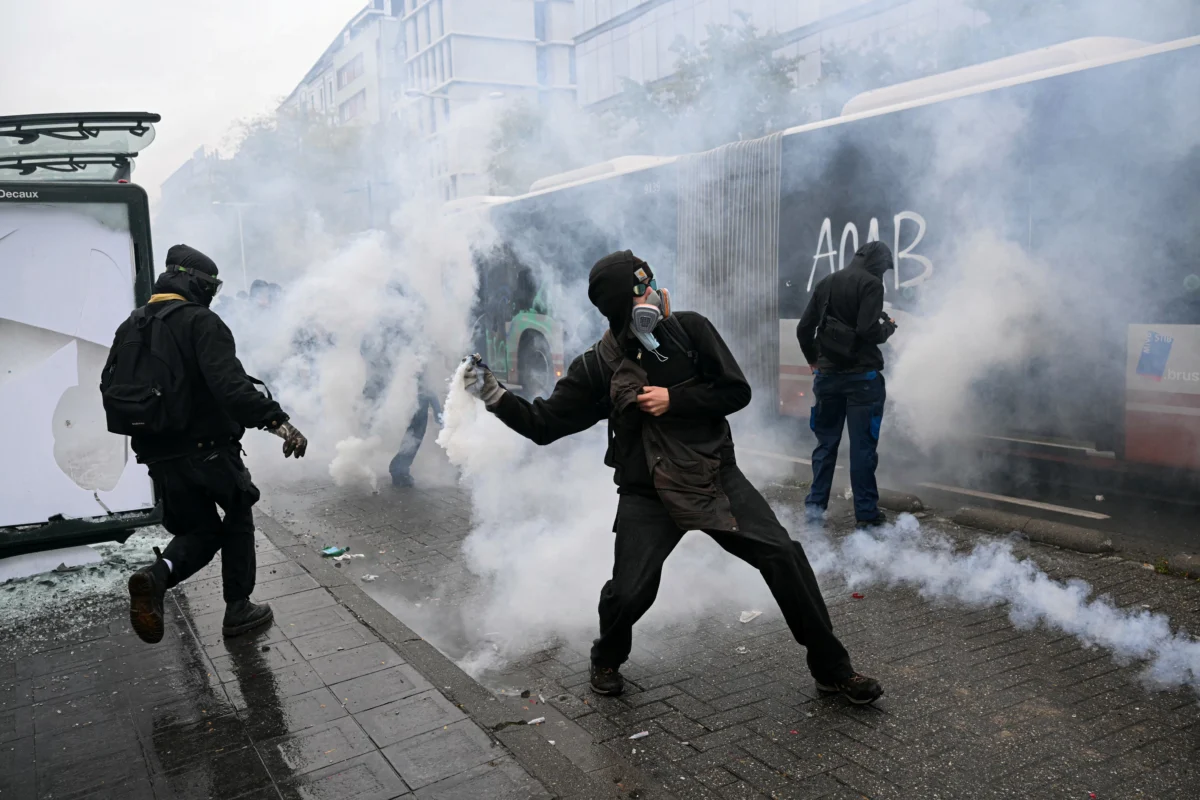
The crisp morning air in the Belgian capital quickly turned acrid on Friday as a wave of civil unrest swept through the streets surrounding Brussels Central and Brussels South railway stations. Thousands of demonstrators had converged on the city center to voice vehement opposition to the federal government’s controversial austerity agenda. Operating under the banner of "stay out of our pockets," the march was organized by Belgium’s two largest labor organizations—the socialist ABVV and the Christian ACV. While the primary trade union procession drew tens of thousands of participants marching in an orderly fashion, the margins of the demonstration devolved into intense urban guerrilla warfare.
Law enforcement authorities deployed heavy details, utilizing tear gas, high-pressure water cannons, and aggressive baton charges to disperse groups of agitators. The confrontation left streets littered with debris, damaged public infrastructure, and a lingering haze of smoke from fires set by rogue elements. The violent escalations in Brussels highlight a volatile domestic political landscape, marked by intersecting grievances over national economic policy, cost-of-living pressures, and simmering youth discontent that has rapidly spread across multiple Belgian cities over the preceding week.
Anatomy of the Unrest and Police Response
The trouble began in the early hours of Friday morning, well before the main body of the trade union march commenced its transit between Brussels Central and Brussels South stations. According to local law enforcement reports and eyewitness accounts, splinter groups—largely consisting of young individuals unaligned with official labor union hierarchies—infiltrated the periphery of the sanctioned gathering.
These individuals engaged in aggressive confrontations with police lines, hurling heavy projectiles including wooden beams, glass bottles, and overturned rubbish bins. Vandalism extended to public amenities, with reports of shared bicycles being set ablaze near transit hubs. The heavy-handed response from riot police was swift. Authorities erected barricades, conducted proactive stop-and-search operations on groups not displaying traditional trade union insignia, and eventually authorized the use of crowd-control munitions.
Rosie Birchard, reporting from the ground for international media, described a cat-and-mouse dynamic between security forces and rioters. Emergency services repeatedly attempted to clear debris and extinguish fires, only for fresh skirmishes to break out. The acrid combination of tear gas and burning material permeated the downtown core. Officials noted that the unrest was not confined to a single fixed location, projecting fears that the street violence could intensify further as daylight waned into the evening hours.
Background Context and Economic Grievances
At the heart of the mass mobilization is deep-seated public anger regarding the federal government’s fiscal strategy. Policymakers in Brussels have been locked in tense deliberations over an upcoming austerity budget designed to curb public debt and meet broader European fiscal targets. However, these proposed budgetary measures have struck a raw nerve among the working and middle classes.
Protesters are specifically aggrieved by contemplated reforms that threaten household purchasing power. Chief among these concerns is the potential modification or undermining of Belgium’s historic wage indexation system—a mechanism that automatically adjusts salaries to match the cost of living. Additionally, public opposition has crystallized around proposed adjustments to value-added tax (VAT) structures and plans to introduce annualized working-time calculations, which critics argue will erode labor protections and lead to longer, less predictable hours.
The ABVV and ACV unions coordinated Friday’s actions to send an unmistakable message to the ruling coalition. While the ABVV spearheaded the main march, estimating turnout at roughly 50,000 people, local police figures placed the attendance closer to a still-substantial 30,000. Concurrently, the ACV deployed a separate, targeted mobilization involving hundreds of activists directly outside the national headquarters of the governing coalition parties, ramping up political pressure on elected officials.

Spillover from Student Unrest and National Escalation
Friday’s violence in Brussels did not occur in a vacuum; it represents the dangerous culmination of a week defined by escalating civil disobedience across the country. Just days prior, the historic city of Liege became the epicenter of intense student-led protests that caught municipal authorities off guard.
Those demonstrations, driven primarily by secondary school and university students demanding increased investment in education and relief from soaring student living costs, quickly boiled over. Protesters in Liege clashed violently with riot police, ransacked local storefronts, and forced authorities to enact emergency municipal bans on public gatherings. The fallout in Liege was severe: over 200 individuals were arrested, and dozens of police officers sustained injuries, setting a tense precedent for the entire nation.
According to sociological observers on the ground in Brussels, many of the younger agitators observed on the sidelines of Friday’s labor march were directly inspired by the radical tactics of the Liege student movement. Furthermore, these youths drew ideological inspiration from ongoing school protests in neighboring France, echoing the spirit of historic student uprisings. These young demonstrators voiced intense frustration with what they perceive as systemic institutional deafness, arguing that neither the educational bureaucracy nor the federal government is listening to the economic and social realities faced by the rising generation.
Official Responses and Divergent Narratives
As the dust settled on Friday afternoon, official channels moved quickly to parse the day’s events into distinct narratives. Representatives for the ABVV and ACV trade unions strongly condemned the opportunistic violence that overshadowed their demonstrations, emphasizing that the rioters hijacked a legitimate, democratic exercise in workers’ rights.
Law enforcement officials echoed this sentiment, formally clarifying that those individuals responsible for severe breaches of public order had no structural or organizational link to the recognized labor unions. Police spokespersons stressed that security forces exercised maximum restraint before deploying non-lethal crowd-control measures, targeting exclusively those engaging in violent vandalism and assault against officers.
Government ministers, meanwhile, faced mounting pressure to address the underlying socio-economic grievances while holding a firm line against lawlessness. Administration officials maintained that fiscal reforms are unavoidable to ensure long-term economic stability, yet they acknowledged the profound anxiety gripping the populace. Political analysts suggest that the severity of the backlash—spanning both organized labor and decentralized youth movements—will severely complicate the ruling coalition’s legislative agenda in the coming weeks.
Broader Implications for the Belgian Political Landscape
The events of Friday mark a critical juncture for Belgium’s socio-political fabric. The convergence of traditional labor resistance with volatile, youth-led street movements creates a volatile formula that traditional mediation channels have struggled to contain.
Economically, the government faces a formidable dilemma. Yielding to union demands regarding wage indexation and taxation could derail the proposed austerity budget and draw scrutiny from European Union fiscal monitors. Conversely, pressing forward with the budgetary measures without substantial compromise risks plunging the nation into prolonged industrial paralysis and sustained civil unrest.
The immediate fallout will likely force a security re-evaluation across major Belgian urban centers. Municipal authorities in Brussels, Liege, and surrounding regions are bracing for further mobilizations, as trade unions weigh the prospect of escalating strike action if the federal government refuses to renegotiate its fiscal framework. As winter approaches, the intersection of economic hardship and hardening ideological stances ensures that the path forward for the Belgian government remains fraught with peril.









