
 Jono Maryono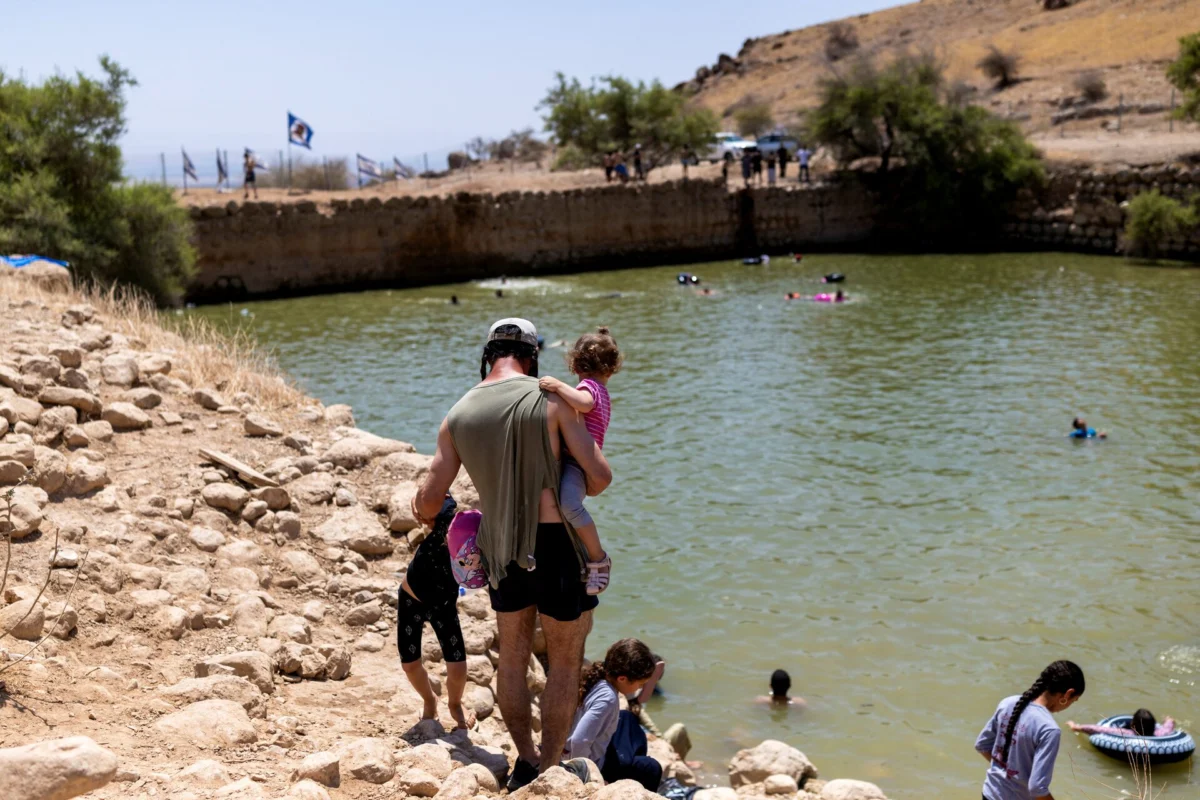
Work has officially begun on an Israeli development project surrounding an outdoor pool in the occupied West Bank, following months of controversy after Israeli settlers illegally diverted vital water resources away from a nearby Palestinian community. Rather than restoring the water access to the village of Fasayil, located near Jericho, Israeli authorities have moved to formalize and rebrand the site as “Herod’s Pool,” invoking the name of an ancient Jewish monarch.
The announcement, made by far-right Israeli Finance Minister Bezalel Smotrich, underscores a broader strategy by Israeli authorities and settler movements to consolidate control over fertile land and historical landmarks in the Jordan Valley. Critics, human rights advocates, and local landowners argue that the project is part of a systemic effort to dispossess Palestinians, monopolize scarce water supplies, and reshape the demographic and archaeological identity of the occupied territories under the guise of heritage preservation.
The Announcement and Official Statements
On a Sunday following months of localized disputes, Israeli Finance Minister Bezalel Smotrich took to social media to announce that “development and preservation” work had officially commenced at the disputed site. The project ties the pool into a wider government-backed initiative aimed at strengthening the Israeli state’s hold on historical sites throughout the occupied West Bank.
Accompanied by images of construction workers and equipment near the reservoir, Smotrich triumphantly declared, “The Settlement Revolution continues!” This latest move directly follows a pledge made by Smotrich in June, during which he allocated more than three million shekels—approximately $1 million USD—toward the development of the site.
The financial backing and official government endorsement proceed despite the fact that the reservoir sits entirely on privately owned Palestinian land belonging to a local farmer and his family. The project has drawn sharp condemnation from human rights organizations, who point out that the infrastructure development legalizes and institutionalizes an initial act of resource theft.
Background Context of the Fasayil Water Dispute
The controversy surrounding Herod’s Pool is deeply rooted in the broader geopolitical struggle over water resources in the Jordan Valley. For decades, human rights groups and international monitors have accused Israel of implementing a system of water apartheid in the occupied West Bank, where Palestinian communities face severe restrictions on drilling wells, accessing natural springs, and maintaining agricultural infrastructure, while adjacent illegal settlements enjoy abundant, uninterrupted water supplies.

Over the summer, tensions in Fasayil reached a breaking point when Israeli settlers repeatedly bypassed local restrictions by illegally diverting water from a natural spring to fill the outdoor reservoir for recreational swimming. According to the Palestinian landowner, Saad Nemer, settlers went so far as to steal his irrigation pipelines to funnel the water into the pool.
Over time, this deliberate diversion starved Nemer’s agricultural land of necessary moisture, leaving his fields scorched, his greenhouses empty, and his primary source of livelihood entirely destroyed. Nemer also reported facing physical intimidation, noting that settlers had repeatedly threatened him and even assaulted one of his farm employees.
Ownership and Documentation of the Land
The reservoir in question is not public property, nor is it a designated state-owned antiquity site. Land registries, historical title deeds, and Israeli-issued administrative documentation reviewed by independent journalists confirm that the land belongs to Saad Nemer and his family. Nemer asserts that his grandfather purchased the property over a century ago, establishing generational ties to the soil that predate the Israeli occupation of the West Bank in 1967.
Despite these clear ownership records, Nemer’s appeals for justice have yielded little practical relief. The Coordinator of Government Activities in the Territories (COGAT), the Israeli military administration body overseeing the occupied West Bank, previously acknowledged that the water diversion occurred “without authorization” and promised to investigate the matter.
Nemer recounted to international press that COGAT officials briefly informed him his water supply would be restored, yet the water flowed back to his farm for a single day before being shut off permanently. Today, Nemer avoids approaching the reservoir to reconnect his irrigation pipeline, paralyzed by legitimate fears of escalating violence and harassment from nearby settlers who now frequent the site under the protection of the newly announced development initiative.
Archaeological Politicization and the Invocation of Herod
The rebranding of the Fasayil reservoir as “Herod’s Pool” is part of a larger, deliberate trend in which Israeli authorities and settler organizations utilize archaeological narratives to cement territorial claims across the occupied West Bank, which the Israeli government officially refers to by its biblical names, Judea and Samaria.
Herod the Great, a Jewish client king of Rome who ruled Judea in the first century BC, is frequently invoked to substantiate ancient historical connections to disputed lands. However, professional archaeologists note that tangible evidence linking specific sites to the king is frequently tenuous or nonexistent. Alon Arad, executive director of Emek Shaveh—an Israeli NGO dedicated to defending cultural heritage rights and monitoring the political manipulation of archaeology—highlighted the dubious nature of these claims.

“We see in many cases the use of archaeology to create this feeling that the West Bank is exclusively Jewish,” Arad stated, pointing to a systematic effort to erase indigenous Palestinian narratives from the landscape.
This phenomenon is not isolated to Fasayil. Similar political and archaeological campaigns have been deployed across the West Bank:
- The Herodium: A sprawling hilltop fortress-palace south of Jerusalem attributed to King Herod, which has been under exclusive Israeli control for decades and operated as a national park despite local Palestinian protests.
- Sebastia: Located in the northern West Bank, this ancient city has received substantial Israeli funding since 2023 to transform its archaeological park into an Israeli national site, sidelining Palestinian efforts to preserve and showcase the ruins as part of their own heritage.
- The Ibrahimi Mosque (Cave of the Patriarchs): Situated in Hebron, this holy site is venerated by both Muslims and Jews. Israel has systematically restricted Muslim access to portions of the mosque, a process defended by settlers who invoke Herodian-era construction to claim exclusive historical ownership. In 2017, UNESCO recognized Hebron’s Old City as an endangered Palestinian heritage site, sparking sharp rebukes from prominent settler figures who cited Herod’s legacy to challenge the international designation.
- Solomon’s Pools: Three ancient reservoirs located in the Bethlehem governorate, traditionally used by local Palestinian communities for generations, which have increasingly faced encroachment and demands for Israeli control by settlers and politicians.
Broader Impact and Implications
The formalization of Herod’s Pool carries significant implications for the future of the occupied West Bank, particularly regarding land tenure, resource management, and the prospects of any future political resolution. By transforming private Palestinian agricultural land into an officially sanctioned Israeli heritage and tourism site, the government is effectively enacting a de facto annexation of the territory.
For local farmers like Saad Nemer, the project signals the permanent loss of their livelihoods and a stark illustration of the vulnerability of Palestinian property rights under military occupation. The intersection of state-backed settlement expansion, the weaponization of archaeology, and the monopolization of critical water infrastructure creates an environment where indigenous communities are systematically pressured off their land.
Furthermore, international legal experts point out that the appropriation of private land and natural resources in occupied territory violates international humanitarian law, specifically the Fourth Geneva Convention. Despite these legal frameworks, the steady progression of projects like Herod’s Pool demonstrates the Israeli government’s intent to deepen its administrative and physical hold over the West Bank, creating irreversible facts on the ground that challenge the viability of a contiguous Palestinian future.









