Johny Marice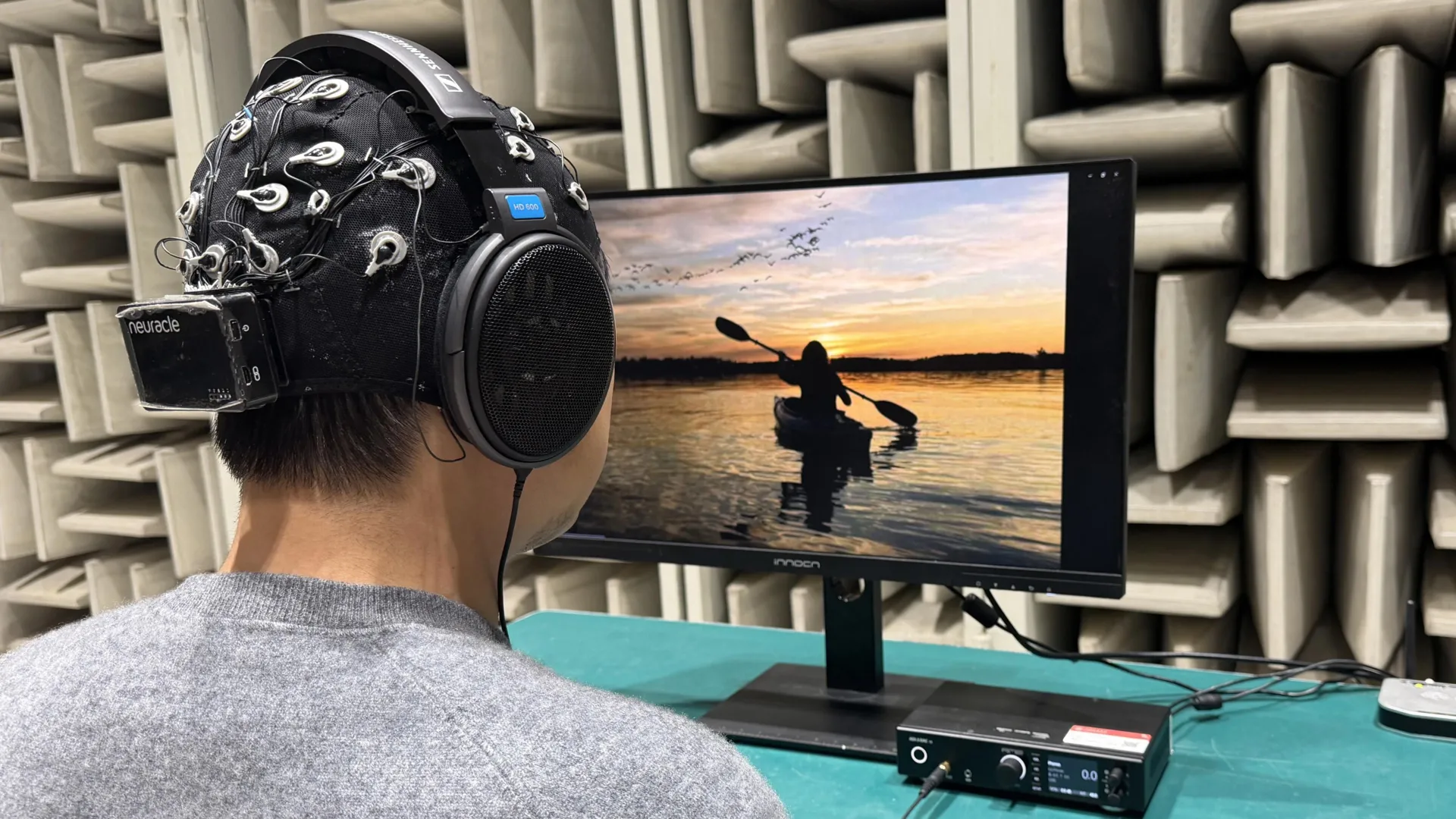
In the quest to discern a faint whisper amidst a cacophony of ambient sounds, a common human instinct kicks in: closing our eyes. The prevailing wisdom suggests that by eliminating visual distractions, our brains can dedicate more cognitive resources to auditory processing, thereby sharpening our hearing sensitivity. This intuitive strategy, honed over millennia, is widely assumed to enhance our ability to perceive subtle sounds. However, a groundbreaking study has challenged this deeply ingrained belief, revealing that this approach can be counterproductive, particularly in environments saturated with background noise. The research, published in the prestigious Journal of the Acoustical Society of America (JASA) by AIP Publishing, offers a compelling new perspective on the intricate interplay between our senses and the complex demands of auditory perception in noisy settings.
Challenging the Conventional Wisdom: A Scientific Inquiry
Researchers at Shanghai Jiao Tong University embarked on a rigorous scientific investigation to empirically test the efficacy of shutting our eyes when trying to hear better in the presence of noise. Their objective was to move beyond anecdotal evidence and common assumptions, employing controlled experimental conditions to dissect how visual input influences our capacity to detect and interpret sounds. The study aimed to provide a definitive answer to the question: does closing our eyes truly improve hearing in noisy environments?
The Experimental Design: A Multimodal Approach to Auditory Detection
The core of the research involved a carefully orchestrated experiment designed to isolate the impact of visual conditions on auditory perception. A group of participants was tasked with a specific auditory detection challenge: listening to a series of sounds through headphones while a predetermined level of background noise played simultaneously. Their primary objective was to meticulously adjust the volume of the target sounds until they were just on the cusp of audibility – the point where the sound was barely perceptible above the masking noise. This "just audible" threshold is a critical measure of auditory sensitivity.
The experiment systematically varied the visual conditions under which participants performed this task. Initially, participants completed the auditory detection exercise with their eyes closed, establishing a baseline for their performance under the traditionally assumed "optimal" auditory focus. Following this, they repeated the identical task under three distinct visual conditions:
- Eyes Open, Blank Screen: Participants kept their eyes open but focused on a completely blank screen. This condition aimed to control for the mere act of keeping the eyes open and processing any visual input, however minimal.
- Eyes Open, Still Image: Participants were presented with a static image that was directly related to the sound they were hearing. For instance, if they heard the sound of a bird chirping, they might see a still photograph of a bird. This condition explored the effect of relevant, but static, visual information.
- Eyes Open, Matching Video: In the final condition, participants watched a video that dynamically and congruently matched the auditory stimulus they were experiencing. If they heard the sound of a drumbeat, they would see a video of someone playing a drum in sync with the audio. This represented the most integrated multisensory experience.
This methodical progression through different visual states allowed the researchers to precisely measure how each level of visual engagement or disengagement affected the participants’ ability to discern faint sounds amidst auditory clutter.
The Surprising Findings: Visual Engagement as an Auditory Aid
The results of the study delivered a significant blow to the widely held assumption that closing one’s eyes enhances hearing in noisy environments. Contrary to popular belief, the data revealed a consistent pattern that defied common intuition.
"We found that, contrary to popular belief, closing one’s eyes actually impairs the ability to detect these sounds," stated lead author Yu Huang in a press release accompanying the study’s publication. This statement directly contradicts the intuitive strategy many people employ.
Furthermore, the study uncovered a powerful synergistic effect when visual and auditory information were congruent. "Conversely, seeing a dynamic video corresponding to the sound significantly improves hearing sensitivity," Huang elaborated. This indicates that rather than being a distraction, relevant and synchronized visual input can act as a powerful facilitator for auditory perception.
The implications are profound: closing one’s eyes, in a noisy setting, made it harder to pick out faint sounds. Conversely, engaging with relevant visual information provided a clear and measurable advantage in auditory detection. This suggests that our sensory systems are not as compartmentalized as we might assume, and the interaction between vision and hearing is far more nuanced and impactful than previously understood.
Unraveling the Neural Mechanisms: Brain Activity and the Paradox of Over-Filtering
To delve deeper into the underlying neural processes responsible for these surprising findings, the research team employed electroencephalography (EEG) to monitor brain activity throughout the experiments. EEG allowed them to observe the electrical patterns generated by the brain as participants engaged with the auditory and visual stimuli.
The EEG data revealed a fascinating neural shift when participants closed their eyes. The researchers observed that eye closure induced a state of "neural criticality" within the brain. While this state is often associated with heightened sensory processing and efficiency, in the context of noisy auditory environments, it appears to lead to an unintended consequence: an increase in how strongly the brain filters incoming information.
This heightened filtering mechanism, while potentially beneficial for blocking out extraneous noise, proved to be a double-edged sword. It not only suppressed the unwanted background noise but also, critically, began to suppress the very target sounds participants were trying to hear. This "over-filtering" phenomenon effectively blinds the auditory system to subtle signals.
"In a noisy soundscape, the brain needs to actively separate the signal from the background," explained Huang. "We found that the internal focus promoted by eye closure actually works against you in this context, leading to over-filtering, whereas visual engagement helps anchor the auditory system to the external world."
This statement highlights a crucial distinction: the internal focus fostered by closing the eyes, while intuitively aimed at enhancing auditory attention, paradoxically hinders the brain’s ability to perform the necessary task of signal-to-noise separation in a challenging acoustic environment. Visual engagement, on the other hand, provides an external anchor, grounding the auditory system and aiding in the process of distinguishing relevant sounds from the surrounding noise.
The Nuance of Context: When Closing Your Eyes Still Offers an Advantage
While the study’s primary findings challenge the universality of closing one’s eyes to improve hearing in noise, the researchers were careful to note that this effect appears to be context-dependent. The detrimental impact of eye closure was most pronounced in the noisy conditions.
"The researchers noted that the effect appears specific to noisy environments," the original report states. "In quieter conditions, closing the eyes may still improve the ability to detect subtle sounds."
This is a critical caveat. In situations where background noise is minimal, the visual system might not be overloaded, and the potential benefits of reducing visual input to focus solely on auditory cues might indeed manifest. Imagine trying to hear a delicate musical note in a silent concert hall – in such a scenario, eliminating any visual distraction could genuinely sharpen auditory focus.
However, the reality of everyday life is often far from silent. Urban environments, social gatherings, and even many professional settings are characterized by significant and pervasive background noise. In these common scenarios, the study strongly suggests that keeping one’s eyes open and actively engaging with visual information is likely to be the more effective strategy for enhancing auditory perception.
Future Frontiers: Deconvoluting Multisensory Integration
The Shanghai Jiao Tong University team is not resting on their laurels. They have outlined ambitious plans for future research to further explore the intricate relationship between vision and hearing. A key question driving their next phase of investigation is the precise nature of the visual benefit observed.
"One key question is whether the benefit comes simply from having visual input or from seeing something that matches the sound," the study indicates. This probes the distinction between general visual processing and the specific advantages of multisensory integration.
To address this, they intend to design experiments that specifically test "incongruent pairings." Huang elaborated on this future direction: "Specifically, we want to test incongruent pairings — for example, what happens if you hear a drum but see a bird? Does the visual boost come from simply having the eyes open and processing more visual information, or does the brain require the visual and audio information to match perfectly?"
Understanding this distinction is paramount. It will help researchers differentiate between the general attentional benefits of simply processing visual information and the more profound advantages derived from the brain’s ability to seamlessly integrate congruent sensory inputs. This deeper understanding of multisensory integration has far-reaching implications, from the design of assistive listening devices for individuals with hearing impairments to the development of more immersive and effective educational tools.
The study’s findings, published in JASA, represent a significant step forward in our understanding of sensory perception. They compel us to re-evaluate our intuitive strategies for enhancing hearing and highlight the powerful, and often counterintuitive, ways in which our senses cooperate and compete. As we navigate an increasingly noisy world, the lesson from this research is clear: sometimes, to hear better, we might need to look more closely.