Reynand Wu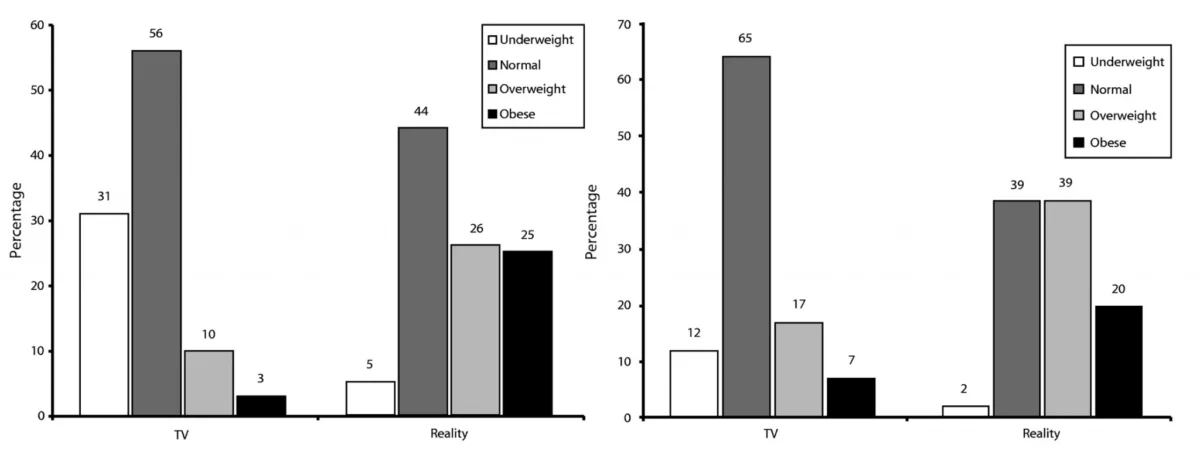
Television, a powerful mirror reflecting and shaping societal norms, consistently distorts, mocks, and marginalizes individuals with larger body types, reducing them to one-dimensional caricatures whose narratives and identities are often overlooked or deemed insignificant. This pervasive misrepresentation not only perpetuates harmful stereotypes but also deeply impacts audience self-perception and contributes to widespread body dissatisfaction.
A foundational study by Tzoutzou et al. starkly illustrates this imbalance, revealing that all 36 compliments related to appearance given to women in their sampled media were directed exclusively towards thin women. Not a single positive message was observed for women with average or overweight body types. A similar pattern emerged for men, with only one overweight character receiving a positive message about their appearance. These findings underscore a deeply ingrained media narrative: external beauty is narrowly defined by thinness, effectively excluding and devaluing anyone who deviates from this restrictive ideal. Viewers, particularly those whose bodies do not conform to this pervasive standard, can internalize this "thin ideal," leading to significant challenges in developing a positive self-image and feeling comfortable in their own skin. The consistent portrayal of larger individuals as objects of ridicule or scorn can profoundly affect how audiences perceive their own bodies, fostering insecurity and self-criticism.
The Underrepresentation Crisis: Bigger Bodies, Smaller Roles
Beyond the overwhelmingly negative portrayal, individuals with larger body types are also significantly underrepresented on television, creating a double bind of invisibility and vilification. Data from studies like Brownell et al. (2003), comparing body types on television to reality from 1999-2000, highlighted a stark disparity. While real-world populations exhibit a diverse range of body sizes, television disproportionately features thin characters, particularly women, creating an unrealistic visual landscape that further alienates and erases a substantial segment of the population. This historical pattern of underrepresentation has shown little sign of significant reversal, even as societal body diversity continues to grow.
This pattern of dehumanization extends to the very depth and complexity of character development. Fat characters are rarely afforded the opportunity to evolve beyond superficial traits, often relegated to predictable roles as comedic sidekicks, tragic figures, or outright villains. Their stories are seldom central, their motivations rarely explored with nuance, and their humanity frequently diminished.
In the realm of comedy, the treatment of larger women is particularly egregious. Research indicates that overweight women are approximately twice as likely to be the punchline of a joke compared to their thinner counterparts. The humor derived is often at their expense, rather than with them, reinforcing a culture of ridicule. These characters also tend to occupy smaller roles, experience fewer romantic relationships, and engage in "fewer positive interactions than thin characters," as one study observed. This contributes to a narrative where larger women are less desirable, less capable of meaningful connection, and inherently less worthy of positive experiences, directly mirroring and potentially influencing real-world biases.
The trope of the "fat villain" is equally prevalent and insidious, particularly in media consumed by young audiences. A study by Himes and Thompson found that in 64% of the most popular children’s videos, obesity was explicitly equated with negative traits such such as evil, unattractiveness, unfriendliness, and cruelty. Iconic examples like Ursula from The Little Mermaid or the Queen of Hearts from Alice In Wonderland visually reinforce this dangerous association, linking physical size to moral depravity. These characterizations serve to demonize larger bodies, subtly instructing young viewers to associate fatness with inherent negativity and threat. This persistent narrative ensures that fat characters are not just ignored, but actively demonized, preventing them from being seen as complex, multi-faceted individuals with rich internal lives, thus stripping them of their humanity in the public imagination.
The Deep Psychological and Societal Effects on Audiences
The relentless negative portrayal of larger individuals in television shows carries profound psychological and societal consequences, leading audiences to internalize harmful stereotypes about being overweight. This internalization can occur with startling speed and impact: a study by Fouts and Burggraf revealed that as little as 30 minutes of television viewing can significantly alter how a young woman perceives her own body, potentially triggering a cascade of external struggles related to body image.
The Tzoutzou et al. study further highlighted this vulnerability, with young girls explicitly acknowledging that media influence fueled their desire to be thin and conform to prevailing beauty standards. This desire often manifests in frequent dieting, a significant precursor to disordered eating patterns. The pursuit of unrealistic body standards, consistently transmitted by mass media, is a major contributing factor to the prevalence of eating disorders and chronic body dissatisfaction among adolescents and adults alike.
Beyond self-esteem issues, these pervasive misrepresentations foster a climate of fear and anxiety. Viewers, particularly women, may come to believe that they will be subjected to the same "sexist ways" and discriminatory treatment depicted on TV if they fail to conform to the dominant body norm. This can lead to preemptive self-objectification, where individuals internalize an external observer’s perspective on their body, constantly monitoring and judging their appearance in an attempt to avoid perceived societal censure. The cumulative effect of these distorted depictions is a pervasive sense of inadequacy, body shame, and a diminished sense of self-worth among female viewers, rooted in fictional and highly damaging portrayals.
Moreover, the perpetuation of fatphobic stereotypes in media contributes directly to real-world discrimination. Individuals with larger bodies face systemic biases in employment, healthcare, education, and social interactions. Media’s role in normalizing negative perceptions exacerbates this issue, making it harder for society to challenge ingrained prejudices. From a public health perspective, this media-driven stigma can discourage individuals from seeking medical care, engaging in physical activity due to fear of judgment, or even lead to mental health challenges that are often overlooked or misattributed.
A Call for Inclusive Storytelling: TV Should Be Fun for Everyone
Television, at its core, is intended to be a source of entertainment, connection, and enjoyment. However, for a significant portion of the audience, this potential is undermined by the constant barrage of judgmental, stereotypical, and exclusionary content. Viewers cannot truly relax and engage with television when they feel their body type is being implicitly, or explicitly, condemned by the very shows they watch. The current media landscape fails to provide a safe and affirming space for all bodies, denying many the simple pleasure of seeing themselves reflected positively and authentically.
The growing body positivity and fat acceptance movements represent a crucial counter-narrative, advocating for diverse representation and challenging the entrenched beauty standards perpetuated by mainstream media. Activists and researchers are increasingly calling on media producers to recognize their immense responsibility in shaping public perception and to embrace inclusive storytelling. Organizations dedicated to promoting positive body image regularly publish guidelines and conduct workshops for media professionals, urging them to move beyond tired tropes and invest in authentic, multi-dimensional character development for individuals of all sizes.
While progress has been slow, a few recent productions have begun to cautiously move towards more inclusive portrayals, featuring characters with larger bodies in roles that transcend their physical appearance, allowing them to be complex, romantic, heroic, and flawed in ways unrelated to their size. However, these instances remain the exception rather than the norm, underscoring the vast work that still needs to be done.
The implications of this media bias extend far beyond individual self-esteem. They touch upon fundamental issues of social equity, mental health, and the very fabric of how we perceive human worth. To foster a more empathetic and inclusive society, television must evolve. All bodies deserve to be seen, celebrated, and normalized across a wide audience, depicted with the same depth, dignity, and diversity afforded to other character types. By consciously challenging and dismantling fatphobic narratives, media creators have the power to transform the viewing experience into one that is truly fun, affirming, and representative for everyone, contributing to a healthier and more accepting world for all. This shift is not merely a matter of political correctness; it is a fundamental ethical imperative for an industry that holds such sway over collective consciousness.