Jono Maryono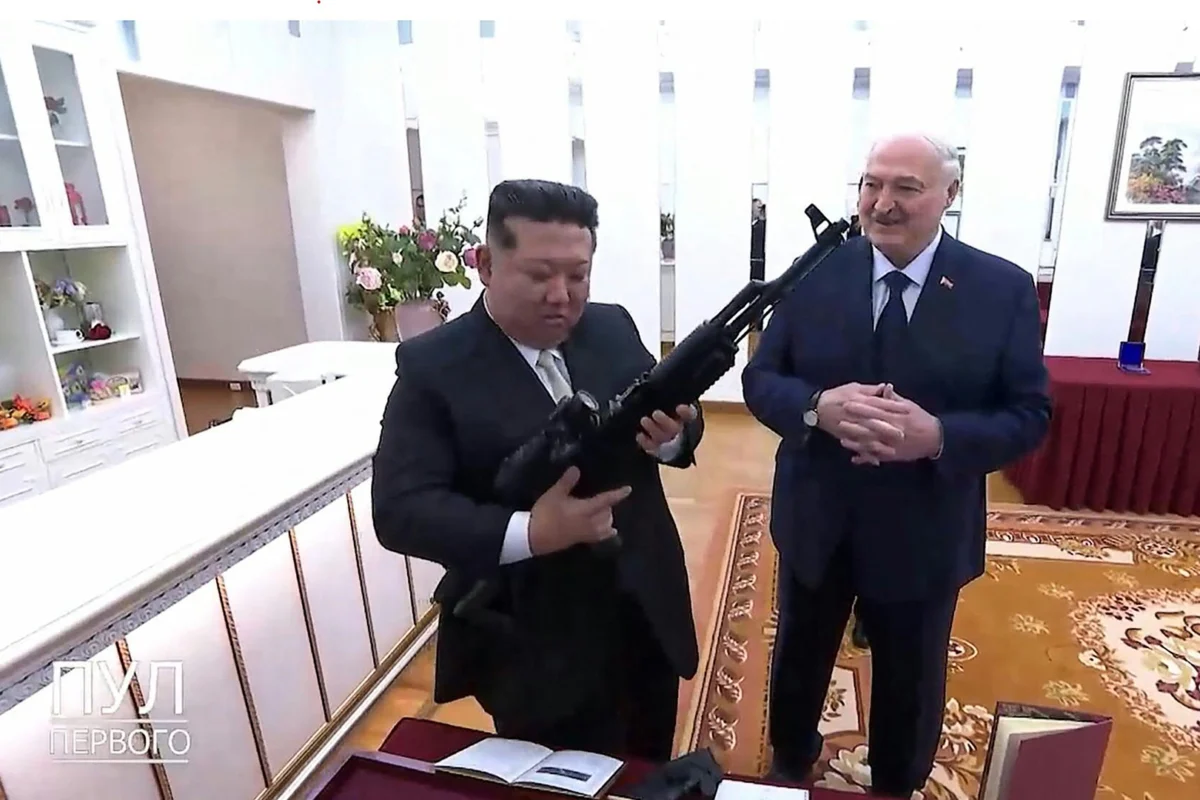
North Korean leader Kim Jong Un received a ceremonial handgun as a gift from Belarusian President Alexander Lukashenko following the signing of a comprehensive friendship treaty between the two nations. The handover occurred during President Lukashenko’s landmark state visit to Pyongyang, marking a significant deepening of diplomatic and strategic ties between the two countries. This high-profile exchange underscores a growing alignment between Pyongyang and Minsk, nations that have increasingly found common ground in their shared opposition to Western-led international norms and sanctions regimes.
The treaty, described by officials as a cornerstone for future cooperation, signifies a commitment to enhanced collaboration across a spectrum of areas, including political, economic, cultural, and security domains. While specific details of the treaty’s security provisions remain undisclosed, the context of the current geopolitical landscape, particularly Russia’s ongoing conflict in Ukraine and heightened tensions on the Korean Peninsula, suggests a potential focus on mutual defense and strategic partnership. The gift of a firearm, often a symbolic gesture in diplomatic exchanges, further accentuates the personal rapport between the two leaders and the perceived strength of their bilateral relationship.
A deepening of ties: The state visit and its significance
President Lukashenko’s visit, the first official state visit by a Belarusian leader to North Korea, represents a significant diplomatic breakthrough. The two leaders have engaged in extensive discussions, the outcomes of which are expected to translate into concrete actions aimed at bolstering their respective economies and enhancing their strategic postures on the global stage. This meeting follows a series of high-level engagements in recent years, including Kim Jong Un’s visit to Russia in September 2023 and Lukashenko’s previous interactions with North Korean representatives.
The timing of this visit is particularly noteworthy. North Korea, under severe international sanctions due to its nuclear weapons and ballistic missile programs, has been seeking to diversify its international partnerships and mitigate the impact of these sanctions. Belarus, also subject to Western sanctions following its alleged complicity in Russia’s invasion of Ukraine, has similarly looked towards non-Western alliances for economic and political support. This shared experience of facing international pressure appears to have forged a strong bond between Pyongyang and Minsk.
Historical context: A growing alignment
The diplomatic relationship between North Korea and Belarus dates back to the early 1990s. However, recent years have witnessed a marked acceleration in their engagement. The conflict in Ukraine, and the subsequent Western sanctions imposed on both Russia and Belarus, has pushed Minsk to seek closer ties with countries that are also at odds with the United States and its allies. North Korea, in turn, has found a willing partner in Belarus, which has shown a willingness to overlook Pyongyang’s human rights record and its illicit activities in exchange for potential strategic benefits.
In the post-Soviet era, both nations have gravitated towards a more centralized governance model and have expressed skepticism towards Western liberal democratic ideals. This ideological resonance, coupled with pragmatic geopolitical considerations, has laid the groundwork for their increasingly robust relationship. The recent visit can be seen as a culmination of these evolving dynamics, moving beyond perfunctory diplomatic exchanges to a more substantive partnership.
The ceremonial gift: A symbol of fraternity
The presentation of a handgun to Kim Jong Un by President Lukashenko is a traditional diplomatic gesture, often symbolizing trust, respect, and a strong bond between leaders and their nations. While the specific make and model of the firearm have not been disclosed, such gifts are typically engraved with insignia or dates to commemorate the occasion. In this context, the handgun serves as a tangible representation of the newly solidified friendship treaty and the personal connection between Kim Jong Un and Alexander Lukashenko.
Historically, firearms have been gifted in diplomatic contexts to signify a readiness for mutual defense or as a mark of high honor. For instance, during the Cold War, such gestures were common between allied nations to underscore shared security interests. The gifting of a gun in this instance, during a state visit and following the signing of a friendship treaty, amplifies the message of a deepening strategic alliance and a willingness to stand together against common adversaries.
Supporting data and analysis: Economic and military implications
While the immediate focus is on the political and symbolic aspects of the visit, the underlying economic and military implications warrant closer examination. North Korea’s economy, crippled by sanctions, is in dire need of external support. Belarus, while also facing economic challenges due to sanctions, possesses a more diversified industrial base, particularly in areas such as heavy machinery, agriculture, and pharmaceuticals.
Potential avenues for economic cooperation could include increased trade in goods and services, joint ventures in industrial sectors, and potentially, North Korean labor exports to Belarus, a practice that has drawn international scrutiny in the past. For North Korea, access to Belarusian markets could provide a much-needed economic lifeline. For Belarus, increased trade with North Korea could offer an alternative to Western markets and a potential avenue to circumvent some of the sanctions’ impact.
From a military perspective, the enhanced cooperation between the two nations could have significant regional implications. North Korea is known for its advanced missile technology and its extensive artillery capabilities. Belarus, a close ally of Russia, could potentially benefit from North Korean military expertise or materiel. Conversely, North Korea might seek access to Belarusian military technology or production capabilities, particularly in areas where Belarus has a stronger industrial base.
The United Nations Security Council has imposed stringent sanctions on North Korea to curb its nuclear weapons and ballistic missile programs. These sanctions prohibit member states from engaging in arms sales or providing military support to Pyongyang. Any cooperation that could be construed as violating these sanctions would draw severe international condemnation and potential countermeasures.
Official Responses and International Reactions
Official statements from both Pyongyang and Minsk have emphasized the peaceful and mutually beneficial nature of their enhanced relationship. North Korean state media has hailed the visit as a triumph of solidarity and a testament to the unbreakable bond between the two peoples. Belarusian media has similarly portrayed the treaty as a strategic imperative, aimed at fostering stability and promoting national interests in a complex global environment.
International reactions are likely to be cautious and closely monitored. Western governments, already critical of both North Korea’s and Belarus’s foreign policy and human rights records, are expected to express concern over the deepening ties. The United States and its allies will likely scrutinize any evidence of military or economic cooperation that could be seen as undermining international sanctions or regional security.
The United Nations Panel of Experts on North Korea, tasked with monitoring the implementation of sanctions, will undoubtedly pay close attention to any developments arising from this renewed partnership. Any perceived violations of sanctions could lead to further diplomatic pressure and potentially new punitive measures.
Broader Impact and Future Implications
The friendship treaty between North Korea and Belarus signifies a growing trend of non-Western alliances forming in response to perceived Western dominance and sanctions regimes. This development could have far-reaching implications for global geopolitics, potentially contributing to a more fractured international order.
For North Korea, strengthening ties with Belarus offers a crucial diplomatic and economic partnership, potentially easing its isolation and providing a buffer against international pressure. For Belarus, it reaffirms its strategic alignment with Russia and other countries that challenge the existing international order, bolstering its position in a multipolar world.
The long-term success of this partnership will depend on a multitude of factors, including the ability of both nations to navigate international sanctions, the genuine economic benefits that can be derived from their cooperation, and the evolving geopolitical landscape. However, the recent state visit and the symbolic gift of a handgun clearly signal a commitment to a deeper and more strategic relationship, the full implications of which will unfold in the months and years to come. This evolving alliance underscores the shifting dynamics of international relations and the persistent efforts of nations to forge their own paths in a complex and often challenging global arena. The commitment to mutual support and the pursuit of shared interests, even in the face of international disapproval, highlights the growing assertiveness of these nations on the world stage.